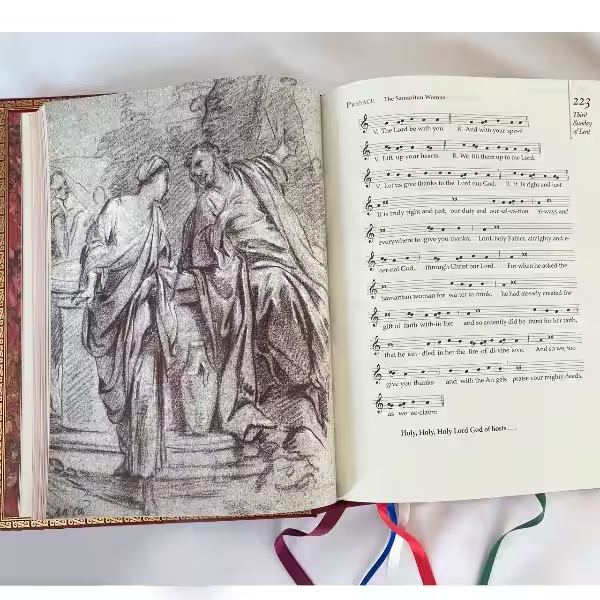
For centuries, the Roman Missal has served as the official liturgical book of the Roman Rite of the Catholic Church. It’s far more than just a collection of prayers and readings; it’s the very blueprint for the Mass, the central act of Catholic worship. Understanding the Roman Missal offers a profound insight into the faith, tradition, and communal prayer life of millions worldwide. It’s a guide that ensures unity and continuity in how Catholics celebrate their most sacred rites, connecting them across time and space to the very origins of their faith.
This comprehensive guide orchestrates every aspect of the liturgical celebration, from the opening procession to the final blessing. Within its pages lie the prayers of the priest, the readings from Scripture, the rubrics (the instructions for how to celebrate), and the order of the Mass itself. The Roman Missal is a living document, evolving through history while steadfastly preserving the essential structure and theological meaning of the Eucharist. Its influence extends beyond the altar, shaping the spiritual lives of countless individuals and communities.
Unpacking the Roman Missal: What’s Inside and Why It Matters
At its core, the Roman Missal is a meticulously crafted volume containing everything necessary for the celebration of Mass. This includes the prayers of the faithful, the consecration prayers, and the words of institution that, according to Catholic belief, transform bread and wine into the Body and Blood of Christ. It also features the lectionary, a structured selection of Scripture readings assigned for each Sunday and weekday throughout the liturgical year, ensuring a rich and varied diet of biblical reflection for the congregation. Imagine it as the script for a sacred drama, where every word and action has deep spiritual significance.
The structure of the Mass, as laid out in the Roman Missal, is consistent and recognizable. This consistency is vital for fostering a sense of communion and universality within the Catholic Church. Whether you are attending Mass in Rome, New York, or Nairobi, the core elements will be the same, guided by the same Roman Missal. This shared experience allows Catholics to feel connected to their global faith community, celebrating the same central mysteries of their religion in a unified manner. It’s a testament to the enduring power of shared tradition and sacred ritual.
The Evolution of the Roman Missal: A Journey Through Time
The Roman Missal has not always been in its current form. Its history is a fascinating journey of development, adaptation, and reform, reflecting the Church’s ongoing engagement with the Gospel and the needs of its people. Early forms of the missal were less standardized, with variations existing from region to region. However, the Council of Trent in the 16th century led to a significant standardization with the promulgation of the “Pius V Missal,” which remained largely unchanged for centuries. This was a crucial step in ensuring liturgical uniformity across the Catholic world.
The most recent major revision, the Roman Missal, Third Edition, was promulgated by Pope Benedict XVI in 2011. This edition incorporated changes following the Second Vatican Council, aiming to make the liturgy more accessible and engaging for the faithful. These changes included new translations of prayers, updated readings, and a richer selection of liturgical texts. For instance, new prayers of the faithful might be introduced to address contemporary social issues, or existing prayers might be rephrased for greater clarity, making the religion of Catholicism more relatable to modern ears.
Theology and Spirituality: The Heart of the Roman Missal
Beyond its practical function, the Roman Missal is deeply imbued with Catholic theology and spirituality. Every prayer, every gesture, every reading is intended to draw the worshipper closer to God. The missal is a profound expression of the Church’s understanding of sacramental theology, particularly the central mystery of the Eucharist. It articulates the belief in the Real Presence of Christ, making the Mass not just a memorial but a true sacrifice and a divine encounter.
The spiritual richness of the Roman Missal is experienced by the faithful through active participation. The prayers are not just for the priest; they invite the congregation to pray, sing, and reflect. The liturgy of the Word nourishes the mind and soul with Scripture, while the liturgy of the Eucharist offers the ultimate spiritual sustenance. By engaging with the texts and actions prescribed in the Roman Missal, individuals can deepen their personal relationship with God and their understanding of the religion they profess. It’s an invitation to encounter the divine in the most intimate and powerful way.
The Roman Missal in Daily Life: More Than Just Sunday Mass
While the Roman Missal is most visibly present during Sunday Mass, its influence extends into the daily lives of many Catholics. The prayers and readings are often used for personal prayer and reflection. Many individuals keep a copy of the missal at home, allowing them to follow along with the liturgy throughout the week, even when unable to attend Mass in person. This personal engagement with the religion fosters a consistent spiritual discipline and a deeper connection to the Church’s prayer life.
Furthermore, the teachings and themes found within the Roman Missal shape Catholic understanding of morality, ethics, and social justice. The lectionary offers timely reflections on the Gospel message, providing guidance for how to live out one’s faith in the world. The prayers often call for charity, mercy, and peace, encouraging the faithful to be agents of God’s love in their communities. The Roman Missal, therefore, is not merely a ritualistic guide but a powerful instrument for spiritual growth and a practical framework for living a life in accordance with Catholic teachings. It’s the engine that drives the spiritual engine of faith.
Frequently Asked Questions about the Roman Missal
What is the Roman Missal?
The Roman Missal is the official liturgical book containing the prayers, rubrics, and rites for the celebration of Mass in the Roman Rite of the Catholic Church. It is the primary guide for priests and deacons when presiding over the liturgy.
What is the purpose of the Roman Missal?
The Roman Missal serves to ensure the unity and fidelity of the Church’s liturgy, providing the prescribed words and actions for the celebration of the Eucharist. It guides the community in praying together and participating in the central act of Catholic worship.
The Roman Missal generally includes the Order of Mass (which outlines the structure and prayers of the Mass), the Proper of the Saints (specific prayers and readings for feast days), and the Common of Saints (prayers and readings that can be used for various categories of saints).
How often is the Roman Missal updated?
The Roman Missal has been subject to revisions throughout history. The most recent significant revision of the Roman Missal in English was promulgated in 2011, with subsequent minor revisions and printings.
Who is responsible for the content of the Roman Missal?
The content of the Roman Missal is determined by the authority of the Holy See, specifically the Congregation for Divine Worship and the Discipline of the Sacraments, under the guidance of the Pope. Local bishops’ conferences are responsible for translating and adapting it for their respective regions.
Can the Roman Missal be changed by individual priests or parishes?
No, individual priests or parishes cannot unilaterally change the content of the Roman Missal. The prayers and rubrics are prescribed by the Church’s authority to maintain uniformity and theological accuracy in the celebration of Mass.
What is the role of the Roman Missal in the religion of Catholicism?
The Roman Missal is central to the religion of Catholicism as it is the authoritative text for the celebration of the Holy Eucharist, the most sacred sacrament in Catholic faith. It embodies the Church’s understanding of faith and worship, passed down through generations.
Where can I find a copy of the Roman Missal?
Copies of the Roman Missal can typically be purchased from Catholic bookstores, online retailers specializing in religious books, and sometimes directly from diocesan offices or publishers authorized by the Church.