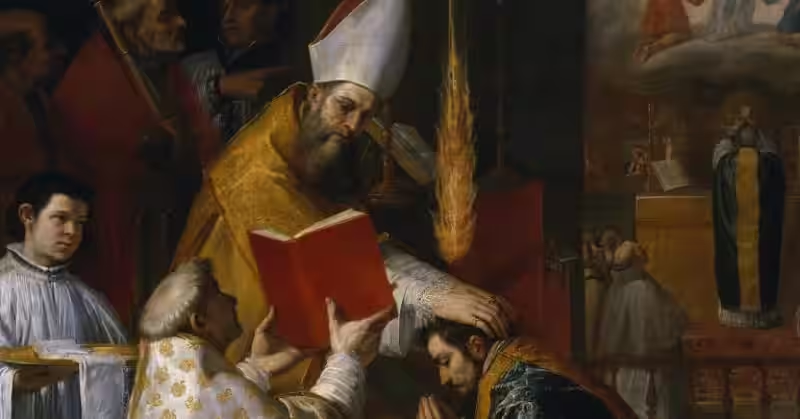
The image of the Roman Catholic priest, a figure often cloaked in humility and dedicated service, frequently brings to mind a particular aspect of their life: celibacy. This commitment, the abstinence from marriage and sexual relations, is a cornerstone of the Latin Rite of the Catholic Church and has been for centuries. Many wonder, “Why are Roman Catholic priests celibate?” This isn’t a simple question with a single, easily digestible answer. Instead, it’s a tapestry woven from threads of theological interpretation, historical development, spiritual discipline, and practical considerations. Understanding this practice requires delving into the rich history and evolving understanding of the priesthood within the Church.
The very essence of the question, “Why are Roman Catholic priests celibate?”, speaks to a deep curiosity about a way of life that stands apart from the norm. In a world where marriage and family are often seen as fundamental human experiences, the voluntary relinquishing of these for a life of dedicated service can seem enigmatic. It’s a choice that demands profound dedication and sacrifice, impacting not only the individual priest but also the community they serve. This article aims to illuminate the multifaceted reasons behind this enduring tradition, offering insights that are both informative and relatable.
The practice of celibacy for priests didn’t appear overnight; it evolved over a long and complex historical trajectory. Initially, the early Church did not mandate celibacy for its clergy. Married men could become priests, and they often continued to live with their wives, albeit with a recognized spiritual dimension to their union. However, as the Church grew and its institutional influence expanded, a desire for a more unfettered dedication to God began to take root among its leaders and theologians.
One of the earliest significant developments occurred in the 4th century. Councils, like the Synod of Elvira in 306 AD, began to encourage or legislate abstinence from conjugal relations for married clergy. This wasn’t a universal, immediate decree but rather a growing trend. The reasoning was multifaceted. A key driver was the idea of purity and consecration. Clergy were increasingly seen as mediators between God and humanity, and a life free from the “distractions” of worldly attachments was considered more fitting for this sacred role. This concept of sacred separateness became increasingly important as the Church developed its liturgical practices and its understanding of the priest as a representative of Christ.
Early Pressures and Developing Discipline
The push towards clerical celibacy wasn’t simply a top-down imposition; it was also influenced by societal and spiritual currents of the time. As the Roman Empire declined, the Church became a significant organizational force, and its clergy often held positions of considerable influence and responsibility. The desire for unquestioned loyalty and undivided attention to the Church’s mission led many to believe that a married clergy might have divided allegiances. Imagine a priest with young children and family obligations; while their love for their family is natural and good, some argued it could potentially detract from their complete focus on spiritual duties and the needs of the wider Church community.
Over centuries, various councils and papal decrees incrementally solidified the requirement. The First Lateran Council in 1123 and the Second Lateran Council in 1139 are often cited as pivotal moments, formally prohibiting the ordination of married men and declaring existing clerical marriages invalid. This wasn’t a smooth process, and resistance existed. However, the momentum towards a celibate priesthood was undeniable. The Church was consciously shaping its clergy into a distinct order, set apart for divine service, and celibacy became a powerful symbol and practical means of achieving this.
Theological Underpinnings: Imitation of Christ and Spiritual Freedom
At the heart of the question, “Why are Roman Catholic priests celibate?”, lie profound theological convictions. The most significant is the concept of imitating Christ. Jesus himself was celibate. He did not marry and dedicated his entire earthly life to his mission of salvation. The Catholic Church views the priesthood as a participation in the person and mission of Christ. Therefore, priests, in their vowed celibacy, are seen as striving to emulate their divine master more fully. This imitation extends beyond mere abstinence; it’s about adopting a radical orientation of life towards God and the service of others, mirroring Christ’s own self-giving love.
This imitation of Christ fosters a specific kind of spiritual freedom. By relinquishing the natural ties of marriage and family, priests are theoretically freed to embrace a universal fraternity and a singular focus on their priestly calling. It allows them to be more available to their congregations, responding to spiritual needs without the constraints or competing demands of a personal family life. Think of a dedicated doctor who chooses to work in remote areas; their commitment means they might miss family events, but their focus is on serving those in need. Similarly, celibacy is seen as enabling a priest’s unrestricted pastoral care and their ability to be a spiritual father to all members of their flock.
The “Eschatological Sign” and Unitive Love
Another crucial theological dimension is the idea of celibacy as an “eschatological sign.” The Church believes that in Christ, humanity’s ultimate destiny – a perfect, resurrected life in communion with God – is already present. Priests, through their celibacy, are seen as living embodiments of this future reality. They are a visible sign of the “kingdom of God” that is not of this world, a foretaste of the heavenly union where marriage as we know it will cease. This concept emphasizes that their love is directed towards a higher, more spiritual communion with God and with all of humanity, transcending earthly limitations.
Furthermore, celibacy is understood to free up a priest’s capacity for unitive love. While marriage is a profound expression of conjugal love, celibacy allows for a different, broader form of love. It’s a love that embraces the entire Church community, a paternal and spiritual love that is meant to be nurturing and self-sacrificing. This is often described as a “spiritual fatherhood,” where the priest, like a father to his children, dedicates himself to the spiritual well-being of his parishioners, guiding them, teaching them, and accompanying them on their faith journeys.
Practical and Spiritual Benefits: Focus and Availability
Beyond the historical and theological justifications, there are tangible practical and spiritual benefits associated with priestly celibacy that continue to be emphasized. One of the most frequently cited is enhanced focus and availability. A priest who is not married has fewer personal domestic obligations. This allows them to dedicate more time and energy to their pastoral duties: celebrating Mass, hearing confessions, offering spiritual direction, visiting the sick, and engaging with their community. Imagine a busy student who chooses not to take on a part-time job; this decision allows them to dedicate all their efforts to their studies, potentially leading to better academic outcomes.
This increased availability is crucial for the demanding and often unpredictable nature of priestly ministry. Emergencies can arise at any hour, and a celibate priest can be more readily available to respond to spiritual crises or urgent pastoral needs within their parish. This commitment to being “on call” for their flock is a practical manifestation of their vocational sacrifice and their dedication to the spiritual welfare of others.
Fostering a Universal Fraternity and Spiritual Discipline
Celibacy also plays a role in fostering a sense of universal fraternity among clergy. By sharing a common bond of vowed celibacy, priests can develop strong bonds of support and solidarity with one another. This shared experience can be a source of encouragement, understanding, and practical help in navigating the challenges of ministry. It creates a brotherhood that can offer solace and strength in the face of loneliness or difficult circumstances.
Moreover, the practice of celibacy is intrinsically linked to spiritual discipline and self-mastery. The deliberate choice to abstain from marriage and sexual intimacy requires ongoing spiritual effort and reliance on God’s grace. This discipline is seen as cultivating virtues like chastity, temperance, and self-denial, which are considered essential for a holy and effective ministry. It’s a constant reminder of the priest’s commitment to a life consecrated to God, fostering a deeper spiritual life and a greater reliance on divine assistance.
Addressing Common Questions and Nuances
It’s important to acknowledge that the topic of priestly celibacy often sparks further questions. A common one is, “Does the Catholic Church have married priests?” The answer is nuanced. While the Latin Rite of the Catholic Church generally requires celibacy for its priests, there are exceptions. Eastern Catholic Churches, which are in full communion with Rome, allow married men to be ordained priests. Furthermore, in some instances, married Anglican or Protestant ministers who convert to Catholicism may be permitted to be ordained as Catholic priests, provided they meet certain criteria and receive special dispensations. This demonstrates a recognition of different traditions within the broader Catholic Church.
Another point of discussion is the difference between celibacy and chastity. While celibacy is a vow of abstinence from marriage and sexual relations, chastity is the virtue of living one’s sexuality according to one’s state in life. For a married person, chastity means fidelity within marriage. For a celibate priest, chastity means abstaining from sexual activity entirely. Both are expressions of living a life ordered towards God, but celibacy is a specific, vowed commitment that encompasses chastity.
The Enduring Commitment and Future Considerations
Ultimately, the practice of Roman Catholic priestly celibacy is a deeply rooted tradition that continues to be embraced by the vast majority of the Church. It is seen as a powerful symbol of dedication, a means of spiritual freedom, and a practical enabler of pastoral ministry. While discussions about its merits and potential changes persist, the current understanding within the Catholic Church is that it serves crucial theological and ministerial purposes.
The question, “Why are Roman Catholic priests celibate?”, leads us to a complex but ultimately rich understanding of a vowed life dedicated to God and the service of His people. It’s a commitment that, for those who undertake it, represents a profound and deliberate choice to prioritize a spiritual union with God and the universal Church above the natural blessings of marriage and family. This enduring practice continues to shape the identity and mission of the Catholic priesthood, a testament to its historical significance and theological weight.
Frequently Asked Questions: Celibacy of Roman Catholic Priests
Why are Roman Catholic priests celibate?
The practice of clerical celibacy in the Roman Catholic Church is rooted in a combination of theological, spiritual, and practical considerations that have developed over centuries. Theologically, it is seen as a way for priests to more fully imitate Christ, who himself was unmarried and dedicated his life to God’s service. This dedication allows priests to be more completely “married” to the Church, their spiritual spouse, and to dedicate their time, energy, and resources to serving the faithful without the demands of a family. Spiritually, celibacy is understood as a discipline that fosters greater focus on prayer, ministry, and the pursuit of holiness, freeing the priest from worldly distractions. Practically, it has been viewed as a way to ensure that Church property and resources are not divided among heirs, and to promote a unified and itinerant clergy who can be readily assigned where needed.
Is celibacy a requirement for all priests?
In the Latin Rite of the Roman Catholic Church, celibacy is a mandatory discipline for priests. However, there are exceptions. Married men who were previously ordained as ministers in other Christian denominations and who convert to Catholicism may be ordained as Catholic priests while remaining married. Additionally, Eastern Catholic Churches, which are in full communion with the Pope, do permit married men to be ordained as priests, though bishops in these rites must be celibate.
Has clerical celibacy always been the norm in the Catholic Church?
No, clerical celibacy as a mandatory discipline developed gradually throughout the history of the Church. In the early centuries, married men were often ordained, and their wives and children lived with them. However, there was a growing understanding and encouragement of celibacy as a more ideal state for clergy, particularly to ensure a greater spiritual focus and to avoid conflicts of interest regarding inheritance. Various councils and synods throughout the Middle Ages solidified and eventually mandated celibacy for priests in the Latin Rite.
Does celibacy mean priests are not allowed to have relationships?
Clerical celibacy requires priests to abstain from marriage and sexual relations. However, it does not mean they must live in isolation or be devoid of human connection. Priests are expected to cultivate healthy, appropriate relationships with family, friends, and parishioners, while maintaining the discipline of celibacy. These relationships are meant to support their ministry and spiritual life, not to compromise their vows.
What are the benefits of celibacy for priests and the Church?
Supporters of clerical celibacy highlight several benefits. It is believed to foster a deeper spiritual life and greater dedication to God and the Church. It allows priests to be fully available for their ministry, without the competing demands of family life. Celibacy can also promote a sense of unity and fraternity among priests and is seen as a tangible witness to the Kingdom of God, pointing towards a different kind of life focused on divine love and service.