The question of where the soul goes after we die is perhaps one of the most profound and enduring mysteries of the human experience. It’s a question that has echoed through millennia, whispered in moments of grief and contemplated in the quiet stillness of contemplation. For countless individuals, the answer lies deeply embedded within their religious beliefs, offering solace, guidance, and a framework for understanding the transition from life to whatever lies beyond. Religion, in its diverse forms, provides a rich tapestry of answers, each weaving a unique narrative about the fate of our spiritual essence.
These religious perspectives aren’t just abstract theological concepts; they are deeply personal and often shape how we live our lives, how we face adversity, and how we say goodbye to loved ones. They offer comfort in the face of the unknown, assuring us that death is not an absolute end but a passage. Whether it’s a reunion with divine beings, a cycle of rebirth, or a state of eternal peace, religious traditions offer a hopeful, albeit varied, vision of what awaits us. Understanding these different viewpoints can provide valuable insights into the human search for meaning and the universal desire for a continuation beyond our earthly existence.
The Abrahamic Traditions: A Journey of Judgment and Eternity
The Abrahamic religions – Judaism, Christianity, and Islam – share a fundamental belief in a personal God and a concept of an afterlife often characterized by divine judgment and a subsequent eternal destiny. The journey of the soul after death is a central tenet, offering a clear path, albeit one that requires moral and spiritual adherence during life.
Christianity: The Path to Heaven or Hell
In Christianity, the prevailing belief is that where the soul goes after we die depends largely on one’s faith in Jesus Christ and their adherence to his teachings. The soul is seen as an immortal entity, separate from the physical body, which continues its existence after death. Upon death, the soul is believed to face a judgment, often referred to as the “particular judgment,” where its earthly deeds and its relationship with God are assessed.
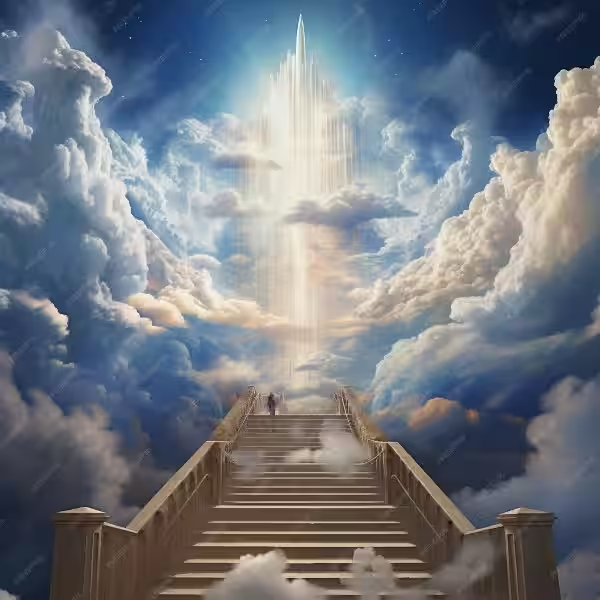
For believers who have accepted Jesus Christ as their savior, the promise is of eternal life in heaven, a state of perfect communion with God in His presence. This heavenly realm is often described as a place of unparalleled joy, peace, and love, free from suffering and sorrow. Conversely, for those who have rejected God’s grace or lived a life of unrepented sin, the consequence is often depicted as eternal separation from God, known as hell. This is understood as a state of suffering and torment, a stark contrast to the bliss of heaven. Some Christian denominations also hold beliefs in purgatory, a temporary state of purification for souls who are saved but still need to atone for venial sins before entering heaven. The concept of resurrection, where the soul will be reunited with a transformed body at the end of time, is also a significant aspect of Christian eschatology.
Islam: Submission and Accountability
Islam, like Christianity, posits that where the soul goes after we die is determined by one’s submission to Allah (God) and their actions during life. Muslims believe in a Day of Judgment, a pivotal event where all individuals will be resurrected and held accountable for their deeds. The soul, known as the ruh, is considered a divine spark, entrusted to humans by Allah.
Upon death, the soul is separated from the body and enters a transitional state, often referred to as barzakh. During this period, the soul experiences a preview of its eternal destiny based on its earthly life. Two angels, Munkar and Nakir, are believed to question the deceased in their grave about their faith and deeds. If the answers are satisfactory, the grave becomes a garden of paradise; if not, it becomes a fiery abyss. On the Day of Judgment, the soul will be reunited with its physical body for the final reckoning. Those whose good deeds outweigh their bad deeds are granted entry into Jannah (Paradise), a place of immense pleasure and spiritual fulfillment, described with vivid imagery of flowing rivers, lush gardens, and eternal bliss. Conversely, those whose sins are more numerous will be consigned to Jahannam (Hell), a place of agonizing punishment, intended as a cleansing fire for believers who sinned, and eternal torment for disbelievers. The core message is one of accountability and the ultimate justice of Allah.
Judaism: A Focus on this Life, with Hints of the Beyond
Judaism, while deeply rooted in the present life and the observance of divine commandments, also grapples with the question of where the soul goes after we die. Unlike some other faiths, Judaism places a stronger emphasis on living a righteous life in this world as the primary way to honor God. The afterlife is not as explicitly detailed or the central focus of religious practice in the same way as in Christianity or Islam.
However, Jewish tradition does acknowledge the existence of an afterlife, with various interpretations throughout history. The most common concept is Olam Ha-Ba (the World to Come), a spiritual realm of reward for the righteous. There’s also the idea of Gan Eden (a Garden of Eden), a paradise for the virtuous, and Gehinnom, often translated as purgatory or a place of purification, where souls undergo a period of cleansing for their sins before potentially entering Gan Eden. The exact nature of Olam Ha-Ba remains a subject of ongoing discussion and interpretation among Jewish scholars. Some believe it is a spiritual existence, while others envision a more physical resurrection. The emphasis, however, remains on living a life of Mitzvot (commandments) and justice as the most direct path to a favorable afterlife. The ultimate fate of the soul is seen as being in the hands of God, a loving and merciful creator.
Eastern Religions: Cycles of Rebirth and Liberation
Shifting our gaze eastward, we encounter religious traditions that offer a fundamentally different perspective on the soul’s journey. Here, the concept of reincarnation, or rebirth, is often central, and the ultimate goal is not necessarily to reach a heavenly paradise, but to transcend the cycle of existence altogether.
Hinduism: Samsara and Moksha
In Hinduism, the question of where the soul goes after we die is intrinsically linked to the concept of Samsara, the continuous cycle of birth, death, and rebirth. The soul, or Atman, is considered eternal and unchanging, transmigrating from one body to another based on the principle of Karma, the law of cause and effect. Every action, thought, and intention creates karmic residues that determine the nature of future lives.
A soul in Hinduism doesn’t simply go to a fixed heaven or hell in the Western sense. Instead, it undergoes a process of transmigration, potentially experiencing various forms of existence – human, animal, or even divine – depending on its accumulated Karma. The ultimate goal in Hinduism is Moksha, liberation from the cycle of Samsara. This state of liberation is not about going somewhere, but about realizing the true nature of the Atman and its oneness with the universal spirit, Brahman. Achieving Moksha signifies the end of suffering and the attainment of eternal peace and bliss. It’s a profound realization of one’s divine essence, a return to the source. The path to Moksha involves various yogic practices, devotion (Bhakti), knowledge (Jnana), and selfless action (Karma Yoga).
Buddhism offers a unique perspective on the soul’s journey, often differentiating itself from other traditions by its doctrine of Anatta (no-self). In Buddhism, there is no eternal, unchanging soul or self in the way many other religions conceive it. Instead, what we perceive as a “self” is a constantly changing aggregation of physical and mental phenomena. Therefore, when we ask where the soul goes after we die, the Buddhist answer is nuanced.
Instead of a soul transmigrating, Buddhism speaks of a continuation of consciousness, a stream of karmic energy that propels beings into a new existence. This cycle of rebirth is known as Samsara, and it is driven by ignorance, attachment, and aversion. The suffering inherent in Samsara is the dissatisfaction and impermanence of all conditioned phenomena. The ultimate goal in Buddhism is Nirvana, a state of profound peace, liberation from suffering, and the cessation of the cycle of rebirth. Nirvana is not a place but a state of being, characterized by the extinguishing of the fires of greed, hatred, and delusion. It is the end of conditioned existence and the attainment of ultimate freedom. The path to Nirvana is the Noble Eightfold Path, a guide to ethical conduct, mental discipline, and wisdom.
Indigenous and Ancestral Beliefs: Connection and Continuity
Many indigenous and ancestral belief systems around the world offer profound and deeply ingrained understandings of where the soul goes after we die. These perspectives often emphasize a strong connection to the earth, the spirit world, and the continuity of life through ancestry.
The Spirit World and Ancestral Reverence
In numerous indigenous cultures, death is not seen as an end but as a transition to a different realm, often referred to as the Spirit World. This Spirit World is not necessarily a place of judgment or reward, but a continuation of existence where the deceased continue to be present and can influence the living. The soul, or spirit, of the departed is believed to join the spirits of their ancestors, who are often revered and consulted for guidance.
The journey of the soul is often depicted as a passage, sometimes through a specific landscape or across a spiritual boundary. The well-being of the living is believed to be intimately connected to the well-being of their ancestors, and rituals and ceremonies are performed to honor them and maintain this connection. The concept of ancestral reverence is paramount, ensuring that the wisdom and protection of those who have passed on are carried forward. The soul’s journey is about maintaining harmony and balance between the physical and spiritual realms. For instance, in some Native American traditions, the soul might travel to a “happy hunting ground,” a perpetual paradise where they can continue their earthly pursuits. In other cultures, the soul might become a guardian spirit for their family or community.
The Enduring Quest for Meaning
Across all these diverse religious landscapes, a common thread emerges: the human yearning for meaning and continuity beyond the finite span of our physical lives. The question of where the soul goes after we die is not merely an intellectual curiosity; it is a fundamental aspect of our search for purpose, our coping with loss, and our anticipation of what lies beyond the veil of mortality.
The beauty of these varied religious perspectives lies in their ability to offer comfort, hope, and a sense of order in the face of the ultimate unknown. Whether it is the promise of eternal paradise, the liberation from suffering, or the continued presence of loved ones in the spirit world, each tradition provides a unique and deeply personal answer. These answers, while differing in their specifics, all serve to affirm the enduring significance of human existence and the possibility of a spiritual continuation. Ultimately, the exploration of where the soul goes after we die through the lens of religion is an ongoing journey of faith, understanding, and the profound human desire to connect with something larger than ourselves.
Frequently Asked Questions: Where Does the Soul Go After We Die?
What do religions generally believe about the soul after death?
Most religions offer beliefs about the soul’s continuation after physical death, though the specifics vary significantly. Common themes include an afterlife, reincarnation, or a return to a divine source.
What do Christians believe happens to the soul after death?
Christianity generally teaches that upon death, the soul of a believer goes to be with God in heaven, while the souls of unbelievers face a separation from God, often described as hell. Some traditions also include purgatory as an intermediate state.
What do Muslims believe happens to the soul after death?
Islam teaches that the soul awaits a Day of Judgment. After death, the soul enters a state called Barzakh, where it experiences a preview of its eternal destination. On the Day of Judgment, the soul will be reunited with its body for final judgment, leading to either Paradise (Jannah) or Hellfire (Jahannam).
What do Jews believe happens to the soul after death?
Judaism has a range of beliefs, with less emphasis on detailed descriptions of the afterlife compared to some other religions. Concepts like Olam Ha-Ba (the World to Come) exist, which can refer to a spiritual afterlife or a perfected messianic age on Earth. Some traditions believe in resurrection of the dead.
What do Hindus believe happens to the soul after death?
Hinduism teaches the concept of reincarnation (samsara), where the soul (atman) is reborn into a new body after death. The cycle of birth, death, and rebirth is influenced by karma, the law of cause and effect. The ultimate goal is moksha, liberation from this cycle.
What do Buddhists believe happens to the soul after death?
Buddhism teaches reincarnation, but with a nuanced understanding. Instead of a permanent soul, it is the stream of consciousness or karmic energy that is reborn. The goal is Nirvana, the cessation of suffering and the cycle of rebirth, achieved through enlightenment.
What do Sikhs believe happens to the soul after death?
Sikhism teaches that the soul goes through cycles of birth and death based on its karma. The ultimate aim is to merge with the divine (Waheguru) and escape the cycle of reincarnation by living a spiritual life, practicing devotion, and performing selfless service.
What do animists and indigenous religions generally believe about the soul after death?
Many animistic and indigenous traditions believe that the spirit or soul continues to exist and can influence the living world. They often believe spirits can inhabit nature, become ancestors who watch over their families, or travel to spirit realms. Rituals and ceremonies are common to honor and communicate with these spirits.