The question, “What does Heaven look like?” has echoed through human history, a persistent whisper of hope and curiosity about what lies beyond the veil of our earthly existence. For millennia, across countless cultures and belief systems, humanity has grappled with this profound mystery, weaving intricate tapestries of understanding and imagery to describe this ultimate destination. It’s a question that speaks to our deepest longings for peace, reunion, and eternal joy. While the specifics vary dramatically, the underlying desire for a place of profound goodness, serenity, and divine presence remains a constant.
This article delves into the rich and varied religious perspectives on the appearance of Heaven, offering a glimpse into the diverse visions that have shaped billions of lives. We’ll explore how different faiths conceptualize this ethereal realm, drawing parallels and highlighting unique interpretations. From the radiant city of Abrahamic traditions to the liberated consciousness of Eastern philosophies, we aim to provide a comprehensive and relatable understanding of these profound beliefs.
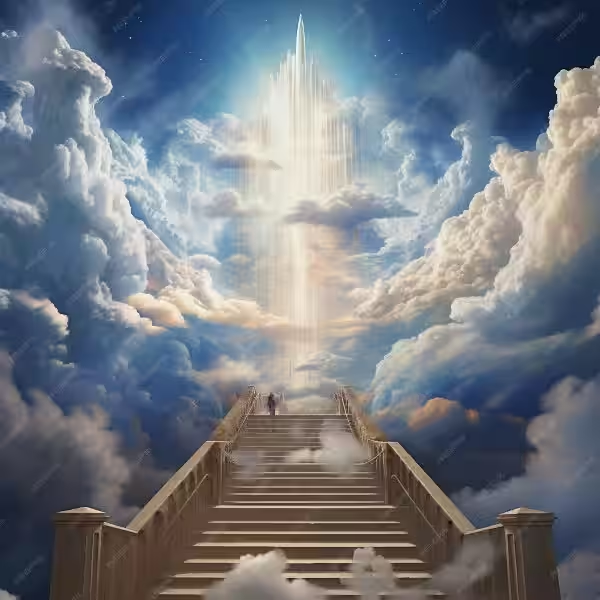
In the Abrahamic faiths – Judaism, Christianity, and Islam – the concept of Heaven often conjures images of a divine dwelling place, a realm of ultimate perfection and closeness to God. For Christians, the Book of Revelation paints a vivid picture of a New Jerusalem, a city of pure gold, with streets paved with precious stones and gates made of pearl. This isn’t just a physical description; it signifies unimaginable beauty, purity, and security. Imagine a place where all suffering is absent, where peace reigns supreme, and where the presence of God is palpable, like a warm, comforting light that permeates everything.
Islam similarly describes Jannah (Paradise) as a place of extraordinary beauty and abundance. Often depicted as lush gardens with flowing rivers of water, milk, honey, and wine, Jannah is a reward for the righteous. Descriptions include splendid palaces, comfortable furnishings, and delightful companions. The emphasis is on sensory pleasures, but these are not merely worldly delights; they are spiritualized pleasures, transcending earthly limitations. The ultimate joy in both Christian and Islamic traditions is the beatific vision, the direct and unhindered experience of God’s glory. This is a crucial aspect of what Heaven looks like – it’s not just about the scenery, but about the unparalleled communion with the divine creator.
Christianity: Streets of Gold and the Lamb’s Light
Within Christianity, the New Testament offers numerous descriptions that contribute to our understanding of what Heaven looks like. The imagery of the New Jerusalem, as found in Revelation 21 and 22, is particularly significant. This celestial city is described as having a great, high wall with twelve gates, guarded by twelve angels, and bearing the names of the twelve tribes of Israel. The foundations of the wall are adorned with twelve kinds of precious stones, and the gates are made of twelve pearls. This meticulous detail suggests a place of ultimate order, beauty, and divine craftsmanship.
Crucially, the Bible states that in this heavenly city, there is “no longer any night, nor do they need the light of a lamp or the sun, for the Lord God will be their light, and they will reign forever and ever.” This highlights a fundamental aspect of the Christian understanding of Heaven: it is a place of everlasting light and presence of God, eliminating darkness, sorrow, and all forms of suffering. It’s a state of being, characterized by perfect peace, joy, and spiritual fulfillment, rather than just a geographical location. The presence of the Lamb (Jesus Christ) is also central, signifying redemption, love, and sacrifice that makes this heavenly existence possible.
In Islam, the Quran and Hadith provide extensive descriptions of Jannah, the Muslim concept of Paradise, further elaborating on what Heaven looks like. These descriptions emphasize a realm of unparalleled bliss and reward for those who have submitted to Allah’s will. It is often portrayed as a series of gardens (Jannat), each more beautiful and exquisite than the last, offering a stark contrast to the trials and tribulations of the earthly life. Imagine stepping into a place where every desire is met, not in a superficial way, but in a manner that deepens spiritual contentment.
Key features include lush vegetation, flowing rivers of pure water, milk, honey, and wine (that intoxicates no one and causes no headache). Believers are said to reside in splendid mansions (Qusur), adorned with precious materials, and enjoy the company of beloved spouses (Hur al-`ayn) and ever-youthful servants. The Quran mentions “rivers of milk the taste of which never changes, rivers of wine delicious to those who drink, and rivers of clear honey.” This sensory richness aims to convey the absolute perfection and joy of Paradise. More importantly, the ultimate reward is the pleasure of Allah: “Allah has promised the believers, men and women, gardens beneath which rivers flow, wherein they shall abide eternally, and good dwellings in gardens of Eden. And the greatest of all is the pleasure of Allah. That is the supreme achievement.” This underscores that the divine pleasure and presence are the pinnacle of heavenly experience.
Beyond the City Walls: Eastern Perspectives on the Ultimate State
While Abrahamic religions often envision Heaven as a distinct, albeit ethereal, place, many Eastern spiritual traditions offer a more nuanced understanding of the ultimate state. These perspectives often focus less on a physical location and more on a state of consciousness or liberation. The emphasis shifts from a reward outside of oneself to a realization of inner truth and freedom. This is not to say there isn’t joy or peace, but these are often seen as intrinsic to achieving a certain spiritual understanding.
In Hinduism, for example, the concept of Moksha represents liberation from the cycle of birth, death, and rebirth (Samsara). It’s not a place one goes to, but a state of oneness with the divine Brahman, the ultimate reality. Imagine shedding all the limitations of your individual ego and realizing your true, eternal nature. Similarly, Buddhism speaks of Nirvana, a state of profound peace, freedom from suffering, and the extinguishing of desire. It’s the cessation of the cycle of suffering, a state of ultimate stillness and enlightenment. These aren’t visual descriptions in the same way as a golden city, but rather profound experiential truths about transcending the mundane.
Hinduism: Merging with the Divine Brahman
In Hinduism, the question of what Heaven looks like is often understood through the lens of Swarga Loka, a celestial realm that is a temporary abode for those who have accumulated good karma but have not yet achieved Moksha. This Swarga Loka is a place of immense pleasure, beauty, and longevity, presided over by the god Indra. It’s a realm where one enjoys the fruits of their good deeds, experiencing a higher level of existence than on Earth. Think of it as a divine resort, a beautiful place where you can relax and enjoy, but it’s not the final destination.
However, the ultimate goal in Hinduism is not Swarga Loka, but Moksha. This is the liberation from the cycle of birth and death, a state of eternal bliss and self-realization. It’s the realization that the individual soul (Atman) is one with the universal consciousness (Brahman). This is not a visual experience in the traditional sense; it’s a profound spiritual awakening. It’s about understanding that you are not merely a body or a mind, but an eternal, blissful spirit, inherently connected to the divine. Achieving Moksha is like dissolving into the ocean of pure consciousness, where all individual distinctions vanish, and there is only absolute peace and understanding.
Buddhism: The Stillness of Nirvana
Buddhism offers a unique perspective on the afterlife, focusing on the cessation of suffering rather than a heavenly destination. The concept of Nirvana is central to this understanding. It’s not a place with golden streets or lush gardens; it’s a state of being, a transcendence of the cycle of rebirth and suffering. Imagine a candle flame being extinguished – not that it ceases to exist, but it ceases to be a flame, it merges into a larger, unmanifest reality. This is a simplified analogy for the profound peace and liberation that Nirvana represents.
The Buddha himself described Nirvana not in terms of its appearance, but in terms of what it is not: it is unconditioned, unborn, unbecome, and unmade. It is the end of craving, aversion, and delusion. While there are descriptions of heavenly realms in Buddhist cosmology, these are considered impermanent states of existence, still within the cycle of Samsara. The ultimate goal is to break free from this cycle entirely. Therefore, in response to what does Heaven look like from a Buddhist perspective, the most accurate answer is that it is the absence of suffering, the ultimate stillness, and the profound realization of truth, a state that is beyond conceptualization and description.
The Unseen Realm: Indigenous and Spiritualist Views
Beyond the major organized religions, indigenous traditions and spiritualist movements offer their own rich and diverse interpretations of the afterlife. These views often emphasize a connection to nature, ancestral spirits, and a cyclical understanding of life and death. The concept of Heaven might not be a singular, static place, but rather a continuum of existence, a spirit world that interweaves with our own.
Indigenous cultures often speak of a “Spirit World” or an “Other Side” where the souls of the departed reside. This realm is frequently depicted as a place of harmony, where spirits can continue to influence and guide the living. It’s a vibrant, living dimension, not a distant paradise. Spiritualism, on the other hand, often describes the spirit world as a place of continued learning and development, where souls progress through various planes of existence, guided by higher beings. The emphasis is on spiritual growth and evolution, rather than a static state of bliss.
Indigenous Beliefs: The World of Spirits and Ancestors
Many indigenous cultures, from Native American tribes to Aboriginal Australians, have rich traditions surrounding the afterlife, offering unique answers to what does Heaven look like. For them, the afterlife is often not a place of judgment and reward in the Abrahamic sense, but rather a continuation of existence in a spiritual dimension. This “Spirit World” is often seen as a place where ancestors reside, maintaining a connection with their living relatives. Imagine a vast, interconnected web of life, where the spirits of those who have passed are still present, offering guidance, wisdom, and protection.
Descriptions vary greatly depending on the specific culture, but common themes include beautiful landscapes, abundant resources, and the presence of spiritual guides. For some, it’s a place of eternal hunting grounds, for others, it’s a realm of ancestral wisdom and communal harmony. The key takeaway is the interconnectedness and continuity of life. It’s not about escaping this world for another, but about transitioning to a different form of existence where the spiritual realm is as real, if not more so, than the physical one. The emphasis is on respect for the departed, the honoring of ancestors, and the understanding that death is not an end, but a transformation.
Spiritualism, a belief system that emerged in the 19th century, offers a distinct perspective on the afterlife that directly addresses the question of what does Heaven look like. Spiritualists believe in the survival of the human spirit after death and its continued existence on various spiritual planes. These planes are often described as realms of increasing light, wisdom, and happiness, where spirits continue their education and development.
Think of it as a cosmic university or a series of evolutionary stages. Each spirit progresses through these planes based on their earthly actions and spiritual development. The “higher” planes are often described as places of profound peace, love, and understanding, filled with beautiful energies and harmonious surroundings, though they are not necessarily visual in the way we understand Earthly landscapes. Communication with the spirit world through mediums is a key aspect of Spiritualism, providing insights into these realms. The ultimate aim is spiritual progression and eventual reunion with the divine source.
The Personal Journey: What Heaven Might Mean to You
Ultimately, while religious traditions offer diverse and compelling visions of Heaven, the question of what Heaven looks like also carries a deeply personal dimension. Our individual experiences, hopes, and fears shape our understanding of this ultimate destination. For some, it might be a reunion with loved ones, a place where all earthly sorrows are forgotten. For others, it might be a state of perfect peace and understanding, a shedding of all anxieties and burdens.
Perhaps the beauty of these varied descriptions lies in their ability to offer comfort, hope, and a sense of purpose to people across the globe. Whether it’s the radiant city, the peaceful stillness, or the interconnected spirit world, these visions serve as powerful reminders that there is something beyond our current existence, something that speaks to our deepest yearning for meaning, love, and everlasting peace. The journey of understanding what Heaven looks like is, in many ways, a reflection of our own spiritual journey and our quest for ultimate fulfillment and belonging.
Frequently Asked Questions About Heaven and Religion
What Does Heaven Look Like?
The appearance of Heaven is described differently across various religious traditions and interpretations. Many traditions believe it to be a realm of ultimate peace, joy, and spiritual fulfillment, often depicted as a place of light, beauty, and divine presence. Some descriptions include lush gardens, celestial cities, and the presence of divine beings or departed loved ones. Ultimately, the visual representation of Heaven is often seen as symbolic of spiritual reality rather than a literal, physical location.
What is Religion?
Religion is a structured system of beliefs, rituals, and practices that typically centers around a supernatural power or powers, the divine, or the sacred. It often provides a framework for understanding the meaning of life, morality, and humanity’s relationship with the cosmos. Religions commonly involve a set of doctrines, ethical guidelines, and communal worship or practices, and offer a way for individuals to connect with something larger than themselves.