In the tapestry of religious practice, certain gestures and pronouncements carry a weight that transcends the ordinary. Among these are apostolic blessings, a profound expression of divine favor and spiritual authority that has resonated through centuries of Christian tradition. These blessings are not mere formalities; they are tangible conduits of grace, connecting believers to the lineage of Christ’s apostles and, by extension, to God Himself. Understanding the significance and practice of apostolic blessings can deepen one’s faith and appreciation for the rich spiritual heritage available within religious communities.
The concept of a blessing, in its broadest sense, is an invocation of divine favor or protection upon a person, place, or thing. Within the religious context, however, a blessing often carries a deeper meaning, implying a transmission of spiritual power or a conferral of divine approval. Apostolic blessings specifically derive their authority from their connection to the original twelve apostles, who were directly commissioned by Jesus Christ. This lineage, passed down through the unbroken succession of bishops in many Christian denominations, imbues these blessings with a unique sacramental character.
The practice of bestowing blessings is as old as religion itself. From ancient rituals invoking divine favor to the pronouncements of prophets and patriarchs, the act of invoking God’s good will has been central to human spiritual aspirations. In early Christianity, the apostles themselves were seen as direct representatives of Christ, endowed with the authority to heal, teach, and indeed, to bless. The New Testament is replete with instances where the apostles, or those acting in their stead, conferred blessings upon individuals and communities, signifying a tangible impartation of spiritual benefit.
Consider the example of St. Paul, who frequently concluded his letters with prayers and well-wishes for the recipients, often invoking God’s grace and peace. These weren’t simply polite closings; they were spiritual acts intended to strengthen the faith of believers and to assure them of their connection to the divine network. This foundational understanding of the apostles as channels of God’s grace is the bedrock upon which apostolic blessings are built. They represent a conscious effort to maintain that vital link to the early Church and its divinely appointed leaders.
The Role of Apostolic Succession
The authority to impart apostolic blessings is intrinsically linked to the doctrine of apostolic succession. This theological concept, particularly prominent in Catholic, Orthodox, and some Anglican traditions, asserts that the authority and mission of the apostles have been passed down through an unbroken line of bishops. Each bishop, through the sacrament of ordination, is considered a successor to the apostles, inheriting their spiritual office and the mandate to administer the sacraments and to govern the Church.
This lineage is often visualized as a spiritual chain, linking the present-day bishops back to the original twelve apostles. Therefore, when a bishop confers a blessing, it is understood as being not just his personal wish, but a blessing carried by the authority of Christ himself, mediated through the apostles and their successors. This concept offers a profound sense of continuity and stability for believers, assuring them that the spiritual gifts and authority of the early Church remain accessible today. It’s akin to receiving a message that has been carefully preserved and delivered through a multitude of trusted messengers across millennia.
How Apostolic Blessings Are Conferred
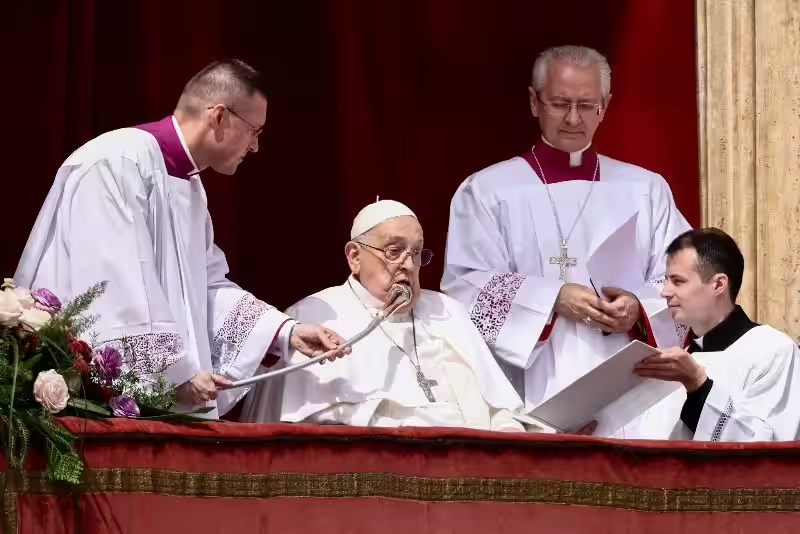
The conferral of apostolic blessings can take various forms, depending on the specific tradition and the context. In many instances, these blessings are bestowed by bishops during liturgical celebrations, such as Mass or other sacraments. The bishop might extend his hands over the congregation, making the sign of the cross and reciting specific prayers of blessing. This public act serves to sanctify the gathered community and to impart a tangible sense of God’s favor upon them.
Beyond public ceremonies, apostolic blessings can also be conferred more personally. A bishop might offer a private blessing to an individual, perhaps someone facing a significant challenge, celebrating a milestone, or seeking spiritual strength. This personal encounter can be incredibly moving, offering a direct connection to the spiritual authority and a powerful reminder of God’s loving presence. Sometimes, even priests, acting under the authority delegated to them by their bishop, can impart certain blessings that carry a strong connection to the apostolic tradition, though the fullness of this authority resides with the bishop.
Examples of Apostolic Blessings in Practice
One common manifestation of an apostolic blessing is the “papal blessing,” which is often granted through a formal document or a special prayer recited by a bishop or priest on behalf of the Pope. These blessings are frequently given for significant life events, such as weddings, anniversaries, ordinations, or even for those who are ill. Receiving such a blessing can serve as a powerful reminder of the universal Church’s prayer and support for individuals and families.
Another relatable example can be found in the traditional blessings offered by bishops at the end of significant liturgical events. Imagine a large gathering for a special anniversary of a cathedral or a major diocesan event. The bishop, as the chief shepherd, will often impart a solemn blessing upon all present, signifying the Church’s prayer for continued faithfulness and divine guidance. This collective experience not only strengthens the bonds within the community but also serves as a potent reminder of their shared spiritual heritage and the ongoing work of the Holy Spirit through the apostolic lineage.
The impact of an apostolic blessing extends far beyond a mere ceremonial act. For believers, it is a concrete expression of God’s love and grace, a spiritual gift that can strengthen faith, offer comfort, and provide courage. It serves as a tangible link to the early Church, reminding individuals that they are part of a continuous, divinely-ordained community stretching back to Christ and His apostles. This connection fosters a sense of belonging and a deeper understanding of one’s place within the grand narrative of salvation history.
Receiving an apostolic blessing can also be a profound source of encouragement during times of difficulty or uncertainty. Knowing that a spiritual leader, empowered with apostolic authority, is praying for and invoking God’s favor upon you can provide immense solace and strength. It’s a spiritual embrace, a confirmation that one is not alone in their struggles, but is supported by the prayers of the Church and the direct intervention of God’s grace. This can lead to renewed hope and a deeper reliance on divine providence.
A Source of Spiritual Strength and Encouragement
The spiritual benefits of apostolic blessings are multifaceted. They can act as a form of spiritual fortification, equipping believers to face life’s challenges with greater resilience. The knowledge that such a blessing has been conferred can instill a sense of peace and confidence, knowing that one is under divine protection and guidance. This is particularly valuable in a world that often feels chaotic and unpredictable, offering a stable anchor in faith.
Moreover, apostolic blessings serve as a powerful reminder of our baptismal promises and our commitment to Christ. They reinforce the idea that our faith is not a solitary endeavor but a communal journey, supported by the entire body of Christ, past and present. This sense of solidarity within the Church, bolstered by the continuity of apostolic authority, can be an immense source of spiritual strength and ongoing encouragement for the journey of faith.
Conclusion: Embracing the Grace of Apostolic Blessings
In conclusion, apostolic blessings represent a vital and enduring aspect of religious life within many Christian traditions. They are more than just words; they are sacred acts that convey divine grace, connect believers to the historical continuity of the Church, and empower them for their spiritual journey. Understanding their origins, their conferral, and their spiritual significance can enrich one’s faith and deepen their appreciation for the profound ways in which God interacts with humanity through His appointed ministers.
By embracing the opportunity to receive and to understand apostolic blessings, individuals can experience a tangible connection to the divine and to the rich heritage of the Church. Whether through a grand liturgical ceremony or a personal encounter with a bishop, these blessings offer a powerful reminder of God’s abiding love and His desire to pour out His grace upon His people. They are a precious gift, readily available to those who seek to draw closer to God and to walk in the light of His perpetual favor.
Frequently Asked Questions about Apostolic Blessings
What is an Apostolic Blessing?
An Apostolic Blessing is a special prayer and patriarchal blessing given by the Pope or a bishop in the Catholic Church. It is often bestowed on significant occasions such as weddings, anniversaries, ordinations, or other important life events. It is considered a spiritual gift, conveying God’s grace and the Pope’s or bishop’s pastoral care.
Who can receive an Apostolic Blessing?
Apostolic Blessings can be requested for individuals or couples celebrating milestones in their lives, such as a wedding, a significant anniversary (e.g., 25th, 50th, 60th), a first Mass, a diaconate or priestly ordination, or for someone who is gravely ill. The blessing is a tangible reminder of God’s favor and the Church’s support.
How is an Apostolic Blessing obtained?
In most dioceses, requests for Apostolic Blessings are handled through the diocesan chancery or a designated office. There is typically a form to fill out detailing the recipient’s name(s), the occasion, and the date of the event. A small donation may be requested to cover administrative costs. It is advisable to apply several weeks in advance of the event to ensure timely delivery.
What is the religious significance of an Apostolic Blessing?
The Apostolic Blessing is a sacramental, meaning it is a sacred sign that derives its power from the spiritual union of the Church. It is an extension of the Church’s ministry and a way to impart spiritual benefits. It signifies the continuity of the apostolic tradition, connecting the recipient to the ministry of the successors of the Apostles, particularly the Pope.
Does an Apostolic Blessing have to be received on a specific date?
While an Apostolic Blessing can be requested for a specific date, such as a wedding anniversary, it is also common to request it to be dated on the actual occasion of the event. Some blessings are printed on parchment and can be framed as a lasting memento.
Is an Apostolic Blessing the same as a papal blessing?
While often used interchangeably, an Apostolic Blessing can be imparted by the Pope or by bishops acting with his authority. A papal blessing is specifically a blessing given directly by the Pope. In practice, the blessing requested through official channels is generally referred to as an Apostolic Blessing and is conferred with papal authority.