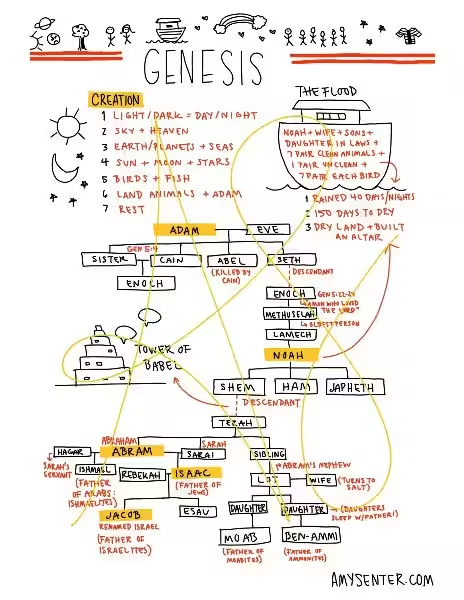
The Genesis narrative, a foundational text for many faiths, introduces us to Eve, a figure whose story resonates deeply with the human experience. Beyond the familiar tale of the Garden of Eden, Eve’s narrative is inherently intertwined with hope – a hope that transcends immediate consequence and points towards a divinely ordained future. This exploration delves into the concept of Eve’s hope within religious traditions, examining its evolution, its significance for believers, and its enduring power to shape our understanding of faith.
The story of Eve in Genesis is often remembered for its dramatic turning point: the act of disobedience that led to humanity’s expulsion from paradise. However, within this very expulsion lies the seed of Eve’s hope. It wasn’t a hope for a return to the Garden as it once was, but rather a divine promise of redemption and a future reconciliation. This promise, however subtle in its initial telling, became a cornerstone for generations of believers, shaping their understanding of God’s enduring love and His plan for humanity.
Immediately following the transgression, God pronounces a curse upon the serpent, a passage often interpreted as the first glimmer of Eve’s hope. The prophecy states, “And I will put enmity between you and the woman, and between your offspring and hers; he will crush your head, and you will strike his heel” (Genesis 3:15). This enigmatic statement, known as the Protoevangelium, is widely seen as a prefiguration of the coming Messiah, a redeemer who would ultimately overcome the forces of evil. For Eve, and for all who followed, this was not merely a pronouncement of future conflict, but a message of ultimate victory, a testament to God’s unwavering commitment to His creation.
Across different religious traditions and theological interpretations, the concept of Eve’s hope has been elaborated upon and understood in diverse ways. While the core promise remains, its nuances and applications have shifted, reflecting broader theological developments and cultural contexts. This evolving understanding highlights the dynamic nature of faith and its ability to adapt while preserving foundational truths.
In Judaism, the focus often rests on the covenantal relationship between God and Israel. While Eve’s specific role might be less emphasized, the overarching theme of divine faithfulness and the promise of a restored kingdom, often embodied by the coming of the Messiah, carries the spirit of Eve’s hope. It’s a hope for a future where justice and peace prevail, a testament to God’s enduring love and His plan for His chosen people, ensuring that the initial promise was not forgotten but continually nurtured.
Christian theology, however, places a significant emphasis on the fulfillment of the Protoevangelium in the person of Jesus Christ. The belief that Jesus, through his life, death, and resurrection, has crushed the serpent’s head—the power of sin and death—is a direct continuation and realization of Eve’s hope. This interpretation transforms the initial promise into a tangible reality for believers, offering a profound sense of assurance and a powerful foundation for their faith, demonstrating that the hope was not merely a prophetic whisper but a resounding declaration of victory.
The Personal Resonance of Eve’s Hope
Beyond grand theological pronouncements, Eve’s hope holds profound personal meaning for individuals navigating their own lives. It speaks to the universal human capacity for endurance, resilience, and faith in the face of adversity. Every challenge, every setback, can be viewed through the lens of this ancient promise, offering a reminder that darkness is not the final word.
Consider the everyday struggles many face: illness, loss, personal failures. In these moments, the story of Eve, and the divine promise embedded within it, can offer a powerful source of comfort and encouragement. It suggests that even in our deepest falls, there is a divine pathway towards healing and restoration. This isn’t about erasing pain, but about finding the strength to persevere, knowing that a brighter future, however distant it may seem, is ultimately assured. This hope fuels the human spirit, enabling individuals to face their own personal “expulsions” with a renewed sense of purpose and belief.
Ultimately, Eve’s hope serves as a foundational element for faith, providing a framework for understanding God’s character and His intentions for humanity. It is a testament to divine love that endures, a promise of ultimate redemption, and a source of enduring strength. This hope is not passive; it actively shapes how believers live, fostering trust in God’s plan, perseverance in trials, and a longing for the fulfillment of His ultimate purposes.
The legacy of Eve’s hope is woven into the fabric of religious tradition, offering a consistent message of divine intervention and eventual triumph. It reminds us that even when facing seemingly insurmountable obstacles, there is an inherent divine assurance of a future where good will ultimately prevail. This belief encourages us to live with purpose and conviction, knowing that our struggles are not in vain, and that a promised future of reconciliation and peace awaits. It is a constant beacon, guiding us through the complexities of life with the unwavering certainty of God’s redemptive plan.
Frequently Asked Questions About Eve’s Hope and Religion
What is “Eve’s Hope”?
“Eve’s Hope” is a fictional theological concept that explores the potential for redemption and a renewed covenant for humanity following a perceived spiritual or existential crisis. It draws upon narratives of creation, fall, and ultimate restoration, often referencing figures and themes found in Abrahamic religions.
How does “Eve’s Hope” relate to traditional religious beliefs?
“Eve’s Hope” is not a formal religious doctrine but rather a philosophical and spiritual exploration. It can be interpreted in various ways, resonating with existing religious themes of salvation, divine intervention, and the promise of a better future. For some, it offers a new lens through which to view established religious narratives, while for others, it might be a source of personal spiritual inspiration.
Is “Eve’s Hope” a recognized religion or denomination?
No, “Eve’s Hope” is not a recognized religion or denomination. It is a conceptual framework that can be engaged with by individuals from diverse religious or non-religious backgrounds. Its value lies in its capacity to provoke thought and discussion about faith, hope, and the human condition.
Can people of different faiths find meaning in “Eve’s Hope”?
Yes, the broader themes of hope, redemption, and finding purpose in the face of adversity that are often associated with “Eve’s Hope” can be meaningful to individuals across different religious and spiritual traditions. The concept invites personal interpretation and application to one’s own belief system.
What are the core tenets or beliefs associated with “Eve’s Hope”?
As a conceptual framework rather than a prescriptive religion, “Eve’s Hope” does not have fixed core tenets. However, it generally revolves around the ideas of:
The possibility of overcoming past transgressions or failures.
The existence of a divine source of comfort and guidance.
The enduring human capacity for faith and spiritual renewal.
The anticipation of a future state of grace or restoration.
Where can I learn more about “Eve’s Hope”?
Information about “Eve’s Hope” can be found in various philosophical, theological, and literary works that explore its themes. Specific resources would depend on the particular interpretation or context in which the concept is being presented. It is often a subject of academic study and personal reflection.