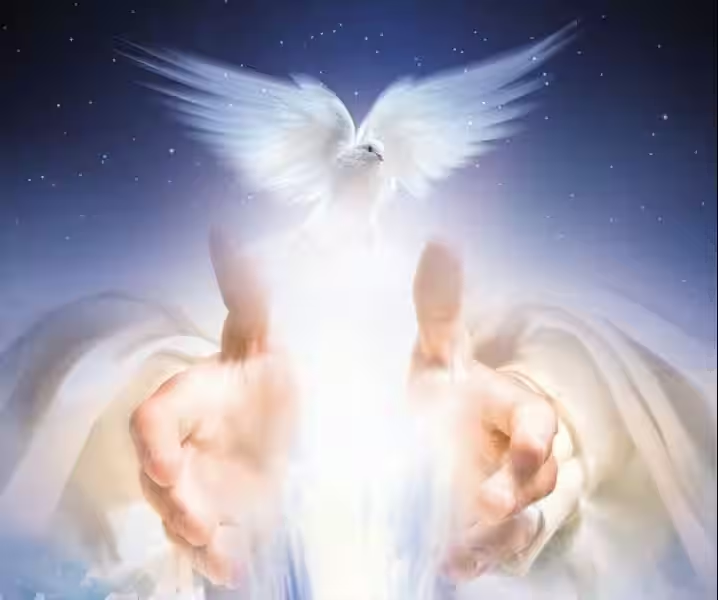
Across the vast landscape of human belief, a singular thread weaves through countless religious traditions, a concept that resonates deeply within the human spirit: the God spirit. It’s the intangible essence, the animating force, the divine presence that many believe permeates existence. This isn’t always a literal, anthropomorphic deity sitting on a celestial throne, but rather a profound, universal energy, a benevolent consciousness that connects all things. Understanding the god spirit is often the gateway to comprehending the core tenets of many faiths, shaping their rituals, their moral codes, and their ultimate aspirations.
From the whispered prayers of ancient peoples to the complex theological arguments of modern scholars, the idea of an omnipresent god spirit has provided solace, meaning, and a framework for navigating the mysteries of life and death. It’s the feeling of awe one experiences in the face of a breathtaking sunset, the inexplicable connection felt during moments of profound love, or the quiet inner voice that guides ethical decisions. This article will delve into the multifaceted nature of the god spirit as it manifests in various religious contexts, exploring its implications for our lives and offering a relatable perspective on this fundamental aspect of human spirituality.
The Nature of the God Spirit: Beyond Form and Flesh
When we speak of the god spirit, we’re often referring to something that transcends physical form. Unlike a king who rules a kingdom or a parent who nurtures a child, the god spirit is frequently described as formless, boundless, and eternal. Consider the wind: you can feel its presence, see its effects on the trees and your hair, but you cannot grasp it in your hand or define its exact shape. Similarly, the god spirit is an unseen force that influences and sustains the universe. This abstract yet potent quality allows for its recognition in diverse cultures and belief systems, each interpreting its manifestation through their unique lenses of religion.
Many traditions view the god spirit as the ultimate source of creation, the prime mover from which all existence springs. It’s the blueprint of the cosmos, the divine intelligence that orders the stars in their courses and guides the growth of every blade of grass. This perspective offers a sense of cosmic order and purpose, suggesting that our lives are not random occurrences but part of a grander, divinely orchestrated plan. The belief in a guiding god spirit can provide a profound sense of security and belonging, anchoring individuals within a reality far larger and more intricate than their immediate surroundings.
Monotheistic Expressions of the God Spirit
In monotheistic religions like Christianity, Islam, and Judaism, the god spirit is often understood as the singular, all-powerful God. While often depicted with attributes of personhood – love, justice, wrath – the divine essence is also recognized as being more than just an individual. For Christians, the Holy Spirit is a distinct person of the Trinity, yet intrinsically one with God the Father and God the Son, representing God’s active presence and power in the world. This spirit is seen as guiding believers, empowering them, and offering comfort. It’s the whisper of divine inspiration that leads to acts of kindness or breakthroughs in understanding.
In Islam, Allah is considered the ultimate, singular God, and His spirit is understood as His divine essence and power. The Quran speaks of God breathing His spirit into creation, signifying His active involvement in bringing life into being. Similarly, in Judaism, while the term “spirit” (ruach) can refer to breath or wind, it also denotes God’s active presence and power. The concept of God’s spirit in these traditions emphasizes His sovereignty and His intimate relationship with humanity, offering a framework for prayer, devotion, and ethical living within the context of their respective religion.
Polytheistic and Pantheistic Interpretations
Moving beyond the singular divine, polytheistic religions, such as ancient Greek or Roman faiths, often feature a pantheon of gods, each with their own domain and characteristics. However, even within these systems, there can be an overarching divine principle or cosmic order that, in a sense, acts as a collective god spirit. The Stoics, for example, spoke of a universal reason or Logos that permeated everything, a divine fire from which all things originated. This concept bridges the gap between distinct deities and a unified divine essence, suggesting that the god spirit can be both immanent and transcendent.
Pantheism takes this idea further, asserting that the god spirit is the universe, and the universe is God. There is no separation between the divine and the material world; everything, from the smallest atom to the grandest galaxy, is an expression of the god spirit. This perspective can foster a deep reverence for nature and a profound sense of interconnectedness with all living things. The rustling leaves, the flowing river, the beating heart – all are seen as vital components of a vast, divine consciousness, offering a deeply spiritual and ecological understanding of religion.
The God Spirit as Inner Guidance and Intuition
Beyond grand cosmic pronouncements, the god spirit is also experienced on a deeply personal level. Many people describe an inner voice, a gut feeling, or a sense of intuition that guides their actions and decisions. This inner knowing is often attributed to the god spirit speaking directly to the individual soul. It’s the feeling of knowing something is “right” or “wrong” without explicit instruction, the nudge towards a path that feels more aligned with one’s true purpose. This internalized god spirit serves as a constant companion, a source of wisdom accessible to everyone, regardless of their formal religion.
Think of a time you were faced with a dilemma, and after much deliberation, a clear course of action simply “clicked.” That moment of clarity, that sudden understanding, can be interpreted as the god spirit illuminating the way. This aspect of the divine is not distant or aloof but intimately involved in the fabric of our everyday lives, offering comfort in times of distress and clarity in moments of confusion. Cultivating this inner connection is a cornerstone of many spiritual practices, aiming to attune oneself to the gentle whispers of the divine presence within.
Experiencing the God Spirit in Daily Life
The god spirit is not confined to sacred texts or ornate temples; it can be found in the most mundane moments, if we learn to recognize its presence. Acts of compassion, moments of shared laughter, the beauty of a blooming flower – these are all potential doorways to experiencing the divine. When we extend kindness to a stranger, we are channeling the benevolent god spirit. When we find joy in the simple pleasures of life, we are resonating with its animating energy. These everyday encounters offer profound, albeit often fleeting, glimpses of the sacred that underpin our religion.
Developing a conscious awareness of the god spirit requires a shift in perspective. It involves moving beyond the purely material and embracing the unseen forces that shape our reality. This can be cultivated through practices such as mindfulness, meditation, prayer, or simply spending time in nature. By intentionally seeking out these moments of connection, we can begin to perceive the pervasive presence of the god spirit, enriching our lives with a sense of purpose, peace, and wonder. It’s about recognizing that the divine is not just “out there” but also “in here,” woven into the very fabric of our being.
Rituals, Prayer, and Connection
Throughout history, religion has developed a rich tapestry of rituals and prayer practices designed to foster a connection with the god spirit. Whether it’s the chanting of ancient mantras, the solemn observance of holy days, or the intimate act of personal prayer, these actions serve to open a channel between the human and the divine. These practices are not merely rote actions; they are deliberate attempts to align one’s consciousness with the higher, spiritual reality that the god spirit represents. They are designed to quiet the noise of the external world and focus inward, creating space for divine communication.
For many, prayer is like having a conversation with a trusted friend, a confidante who listens without judgment and offers solace and guidance. It’s a way to express gratitude, to seek help, or simply to acknowledge the ever-present god spirit. Similarly, rituals can create a sacred container, a space set apart from ordinary life, where one can more easily commune with the divine. These structured engagements with the spiritual realm can provide a sense of comfort, community, and a tangible link to something greater than oneself, reinforcing the tenets of their religion.
The God Spirit and Ethical Living
The concept of the god spirit is inextricably linked to ethical and moral principles across virtually all religious traditions. If a divine, benevolent spirit exists, then it follows that aligning our actions with its perceived nature – characterized by love, compassion, justice, and truth – is of paramount importance. The god spirit is often seen as the ultimate arbiter of morality, the source from which all right and wrong emanate. Therefore, living ethically is not just a social obligation but a spiritual imperative, a way of honoring and reflecting the divine essence within and around us.
Consider the Golden Rule, a principle found in many religions: “Do unto others as you would have them do unto you.” This universal ethic is a direct reflection of the perceived nature of the god spirit – a call for empathy and mutual respect. When we act with integrity, when we forgive those who have wronged us, when we strive for fairness, we are embodying the qualities of the divine. This deep connection between the god spirit and ethical behavior provides a powerful motivation for personal growth and contributes to the well-being of individuals and communities, reinforcing the profound impact of religion on societal values.
The god spirit remains one of the most enduring and transformative concepts in human history, a testament to our innate yearning for meaning and connection. Whether understood as a personal deity, a universal consciousness, or an inner guiding force, its presence is felt across the spectrum of religion and spirituality. It is the unseen current that flows through the universe, animating life, inspiring love, and guiding us towards a deeper understanding of ourselves and our place in the grand cosmic dance.
To truly embrace the god spirit is to cultivate an attitude of openness and receptivity. It means looking beyond the superficial and seeking the sacred in the everyday, listening to the quiet whispers of intuition, and striving to live in accordance with the principles of love and compassion. By doing so, we can tap into a profound source of strength, wisdom, and peace, allowing the divine essence to illuminate our path and enrich every aspect of our lives. The journey of understanding the god spirit is a lifelong exploration, a continuous unfolding of awareness that promises a deeper, more meaningful existence within the framework of our chosen religion.
Frequently Asked Questions about God, Spirit, and Religion
What is God?
The concept of God varies widely across different religions and belief systems. Generally, God is understood as a supreme being, creator, and sustainer of the universe, often characterized by attributes such as omnipotence, omniscience, and omnipresence.
What is the spirit?
The spirit is often described as the non-physical essence of a person, a divine spark, or a connection to a higher power or universal consciousness. It is considered the part of an individual that is immortal and transcends the physical body.
What is religion?
Religion is a structured system of beliefs, practices, rituals, and ethics that typically relates humanity to something considered sacred, supernatural, or divine. It often provides a framework for understanding the meaning of life, morality, and the afterlife.
How are God, spirit, and religion related?
In many religious traditions, God is seen as the ultimate source of the spirit, and religion serves as a path or guide to understanding and connecting with both God and one’s own spirit. Religion provides the doctrines, rituals, and community that help adherents explore these concepts.
Are there different beliefs about God, spirit, and religion?
Yes, there is immense diversity in beliefs. Monotheistic religions (like Christianity, Islam, Judaism) believe in one God. Polytheistic religions (like Hinduism, ancient Greek religion) believe in multiple gods. Pantheistic views see God as identical with the universe. Atheism denies the existence of God, while agnosticism asserts that the existence of God is unknowable. Similarly, concepts of the spirit and the role of religion vary greatly.
Can one have beliefs about God and spirit without adhering to a religion?
Absolutely. Many individuals identify as spiritual but not religious (SBNR). They may believe in a higher power or the existence of a spirit without following the dogma or institutional practices of a formal religion.