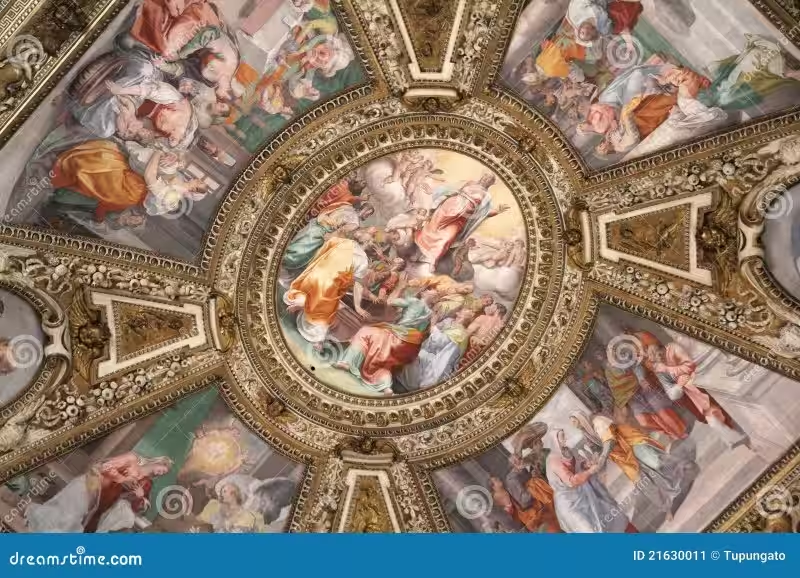
For centuries, the stones of Rome have whispered tales of faith, power, and artistic genius. Within its hallowed churches, a breathtaking legacy of Roman church art unfolds, serving not merely as decoration, but as a profound expression of religion, a visual sermon that has guided, inspired, and humbled generations. This art isn’t confined to hushed museums; it’s an active participant in the spiritual lives of countless individuals, transforming sacred spaces into portals to the divine and imprinting indelible images of faith onto the collective consciousness.
Stepping into a Roman basilica is an immediate immersion into a world where art and religion are inextricably linked. The sheer scale of some of these architectural marvels, coupled with the intricate details of their decoration, speaks volumes about the ambition and devotion of those who commissioned and created them. From the soaring domes that reach towards the heavens to the shimmering mosaics that tell stories of salvation, Roman church art offers a comprehensive visual narrative of Christian doctrine, history, and the enduring human quest for meaning.
The Divine Canvas: Early Christian Art and the Foundations of Faith
The genesis of Roman church art can be traced back to the early days of Christianity, a period marked by both persecution and burgeoning spiritual fervor. In the subdued and often hidden spaces of catacombs, early Christians began to express their beliefs through simple yet potent imagery. These stylized figures, often found on sarcophagi and tomb walls, would become the foundational language of Christian iconography. Think of the Good Shepherd, a recurring motif symbolizing Christ’s protective love, or the Chi-Rho, an early Christian symbol formed from the first two letters of Christ’s name in Greek. These early artistic expressions were not about grand spectacle, but about conveying core tenets of belief and offering solace in a challenging world.
As Christianity transitioned from a clandestine faith to the official religion of the Roman Empire, its artistic expression began to flourish and expand. The construction of grand basilicas, adapted from Roman public buildings, provided a much larger and more public canvas. This era saw the rise of mosaics, particularly in places like Ravenna and Rome itself. These vibrant tesserae, crafted from colored glass and stone, were designed to capture and reflect light, imbuing the interiors with a celestial glow. Imagine the Empress Theodora and her court, immortalized in the luminous mosaics of San Vitale in Ravenna; this was art meant to serve as a constant reminder of the divine presence and the earthly representation of God’s kingdom. The iconography became richer, incorporating Old and New Testament scenes, the lives of saints, and allegorical figures, all intended to educate and inspire the faithful.
From Catacombs to Camels: The Evolution of Symbolism and Narrative
The visual language of Roman church art was never static; it adapted and evolved, responding to theological developments, cultural influences, and the changing needs of the Church. The early, somewhat abstract symbols gradually gave way to more naturalistic representations, allowing for a deeper emotional connection with the depicted figures. The stories of the Bible, which might have been inaccessible to many through written text alone, were brought to life through these visual narratives. Consider the depiction of the Nativity or the Crucifixion – these pivotal moments in Christian history were rendered with increasing detail and emotional intensity over time, making the sacrifice and redemption of Christ palpable for viewers.
Furthermore, the use of symbolism remained a crucial element, even as representations became more realistic. A lily might represent purity, a dove the Holy Spirit, and a lamb Christ himself. These visual cues acted as a shorthand for complex theological ideas, making them accessible to a wider audience. The apse mosaics found in many Roman churches, often depicting Christ Pantocrator (all-powerful) or the Virgin Mary enthroned, served as the focal point of the sanctuary, drawing the eyes of worshippers upwards and inwards towards spiritual contemplation. The sheer artistry involved, from the meticulous placement of individual tesserae to the harmonious blend of colors, aimed to create an environment that was both awe-inspiring and conducive to prayer and reflection.
The Renaissance Rebirth: Humanism and Heavenly Masterpieces
The Renaissance marked a pivotal shift in the history of Roman church art. While still deeply rooted in religion, this period saw an unprecedented fusion of artistic brilliance and humanist ideals. Artists like Michelangelo, Raphael, and Leonardo da Vinci brought a new level of anatomical accuracy, emotional depth, and technical mastery to religious subjects. The focus shifted slightly, not necessarily away from the divine, but towards a more profound understanding of the human experience within a spiritual context. The divine was now often depicted through the lens of idealized, yet profoundly human, forms.
The Sistine Chapel ceiling, painted by Michelangelo, is perhaps the most iconic example of this Renaissance synthesis. The sheer scale and complexity of the frescoes, depicting scenes from Genesis, are a testament to artistic genius. Yet, beneath the breathtaking artistry lies a profound theological narrative. The Creation of Adam, with God’s finger reaching out to touch Adam’s, encapsulates the divine spark of life and humanity’s creation in God’s image. These works were not just beautiful; they were intended to educate, inspire, and elevate the viewer, demonstrating the power of God through the perfection of human form and the drama of biblical accounts. The Last Supper, in its various interpretations, also became a focal point, exploring themes of loyalty, betrayal, and Christ’s sacrifice with unprecedented psychological insight.
Sculpting Faith: Bernini and the Baroque Embrace of Emotion
Following the Renaissance, the Baroque era injected a new sense of drama, movement, and emotional intensity into Roman church art. Artists like Gian Lorenzo Bernini became masters of capturing fleeting moments and evoking powerful feelings. His sculptures, such as the Ecstasy of Saint Teresa, are not simply static figures; they are alive with emotion, conveying a palpable sense of spiritual rapture and divine encounter. The dramatic use of light and shadow, the swirling drapery, and the dynamic poses all contribute to an immersive and theatrical experience designed to stir the soul.
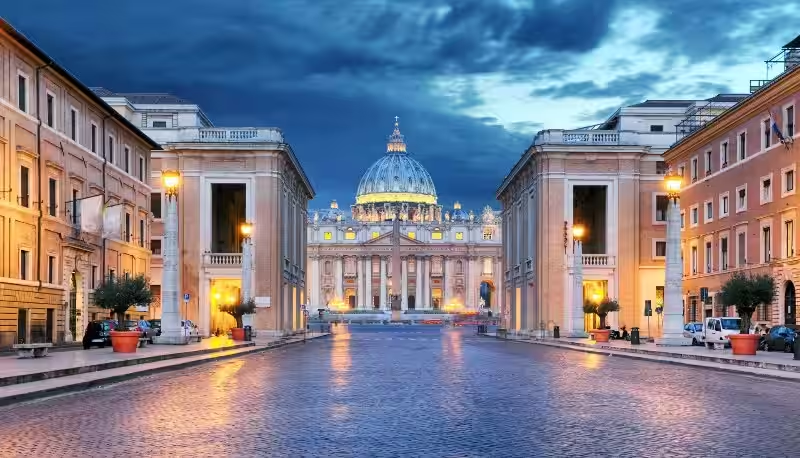
Bernini’s approach to Roman church art was revolutionary. He understood that art could be a powerful tool for religious persuasion and spiritual engagement. The colonnade of St. Peter’s Square, designed by Bernini, embraces visitors as they approach the basilica, drawing them into a sacred embrace. Inside, his works, such as the Cathedra Petri (Chair of Saint Peter), blend sculpture, architecture, and stained glass to create a unified and overwhelming expression of faith. The Baroque style aimed to overwhelm the senses, to create a spiritual experience that was both intellectually stimulating and deeply emotional, drawing worshippers into a more intimate and fervent relationship with God.
Art as a Pathway to the Sacred: The Enduring Relevance of Roman Church Art
Today, the Roman church art that adorns the city’s sacred spaces continues to serve its fundamental purpose: to connect people with the divine. Whether it’s a tourist marveling at the grandeur of St. Peter’s Basilica, a local seeking solace in a quiet chapel, or an art historian studying the evolution of artistic expression, the impact of this art remains profound. The stories depicted, the emotions evoked, and the sheer beauty of the craftsmanship all contribute to a spiritual experience that transcends time and individual belief systems.
The enduring legacy of Roman church art lies in its ability to communicate universal themes of love, sacrifice, redemption, and hope. These artworks are more than just historical artifacts; they are living testaments to the power of faith and the enduring human need for spiritual connection. They invite us to contemplate our place in the larger cosmic order, to reflect on the teachings of religion, and to find beauty and meaning in the world around us. The next time you find yourself in Rome, or even encountering reproductions of its sacred art, take a moment to truly look. You might just find a piece of yourself reflected in the divine canvas.
Frequently Asked Questions About Roman Church Art and Religion
What is Roman Church Art?
Roman Church Art refers to the artistic creations commissioned, produced, or inspired by the Roman Catholic Church throughout its history, particularly within Rome and its sphere of influence. This encompasses a vast range of visual arts, including painting, sculpture, architecture, mosaics, and more, all serving religious purposes and reflecting theological beliefs and devotional practices.
What are the key periods of Roman Church Art?
Key periods include:
Early Christian Art (c. 3rd – 6th centuries): Characterized by catacomb paintings, early basilicas, and symbolic imagery.
Byzantine Art (c. 6th – 15th centuries, with significant influence in Rome): Known for its opulent mosaics, icons, and hierarchical compositions.
Romanesque Art (c. 10th – 12th centuries): Marked by robust architecture, monumental sculpture, and narrative frescoes.
Gothic Art (c. 12th – 14th centuries): Though more prominent in Northern Europe, Gothic elements influenced Roman churches with taller structures and stained glass.
Renaissance Art (c. 14th – 16th centuries): A golden age of artistic patronage in Rome, producing masterpieces by artists like Michelangelo, Raphael, and Bramante, focusing on humanism and classical ideals within a religious context.
Baroque Art (c. 17th – 18th centuries): Characterized by dramatic intensity, emotional expression, grandeur, and illusionism, exemplified by artists like Bernini and Caravaggio.
Neoclassical and Later Periods (19th century onwards): Saw revivals of classical styles and continued engagement with religious themes.
What are the primary functions of Roman Church Art?
The primary functions of Roman Church Art are:
Instruction and Didacticism: To teach biblical stories, the lives of saints, and theological concepts to a largely illiterate population.
Devotion and Worship: To inspire prayer, facilitate contemplation, and create a sacred atmosphere for worship.
Glorification of God and the Church: To express the majesty and omnipresence of God and the power and authority of the Church.
Memorial and Commemoration: To honor saints, popes, and important figures, and to commemorate significant events in Christian history.
Aesthetic and Experiential: To provide a visually and spiritually engaging experience for worshippers.
How does Roman Church Art reflect religious beliefs?
Roman Church Art is deeply intertwined with Catholic doctrine and beliefs.
Christology: Depictions of Christ’s life, suffering, and resurrection convey core tenets of Christian salvation.
Mariology: The veneration of the Virgin Mary is evident in numerous artworks, highlighting her role as Mother of God.
Sainthood: The portrayal of saints serves as exemplars of faith and intercessors for believers.
Sacraments: Art often illustrates the sacraments, such as the Eucharist and Baptism.
Theological Concepts: Themes like the Trinity, the Last Judgment, and the Communion of Saints are visually represented.
Symbolism: Recurring symbols like the lamb, the cross, the dove, and specific colors carry profound religious meaning.
What are some famous examples of Roman Church Art?
Famous examples include:
St. Peter’s Basilica: A monumental example of Renaissance and Baroque architecture, housing Michelangelo’s Pietà and Bernini’s Baldacchino.
Sistine Chapel: Renowned for Michelangelo’s ceiling frescoes depicting scenes from Genesis and his Last Judgment fresco.
Churches of Rome: Many churches, such as Santa Maria Maggiore (mosaics), San Clemente (diverse artistic layers), and Il Gesù (Baroque facade and ceiling), are treasure troves of church art.
Vatican Museums: Home to vast collections of religious art spanning centuries, including Raphael’s Stanze.
How has the relationship between art and religion evolved in the Roman Church?
The relationship has evolved significantly:
Early Christian Period: Art was often discreet and symbolic, adapting pagan forms for Christian use.
Medieval Period: Art became more didactic and monumental, serving the institutional Church.
Renaissance: A period of humanistic influence where artists gained greater individual recognition, though still serving religious patronage.
Baroque: Art became highly theatrical and emotional, aiming to inspire awe and reaffirm Catholic faith during the Counter-Reformation.
Modern and Contemporary: While traditional forms persist, contemporary artists engage with religious themes in more diverse and sometimes abstract ways, reflecting changing societal contexts.