The Book of Revelation, the final and often enigmatic book of the Christian New Testament, is a tapestry woven with visions, symbols, and prophecies. For many, particularly those with a connection to the Abrahamic faiths, one of the most compelling and frequently debated aspects of Revelation revolves around its pronouncements concerning Israel. Understanding what Revelation says about Israel isn’t just about deciphering ancient texts; it’s about exploring themes of divine judgment, ultimate redemption, and the enduring covenantal relationship between God and His chosen people. This exploration delves into the multifaceted ways this complex book addresses the nation and its significance.
The imagery in Revelation is potent, often painting vivid pictures of spiritual battles and cosmic events. When we ask, “What does Revelation say about Israel?”, we are tapping into a deep well of theological discussion that has spanned centuries. It’s a journey that requires careful consideration of the symbolic language, historical context, and the overarching narrative of God’s redemptive plan. This article aims to illuminate these crucial aspects, making the often-daunting prophecies of Revelation more accessible and relevant to contemporary understanding.
The Symbolic Representation of Israel in Revelation
Identifying the “Tribes of Israel” and Other References
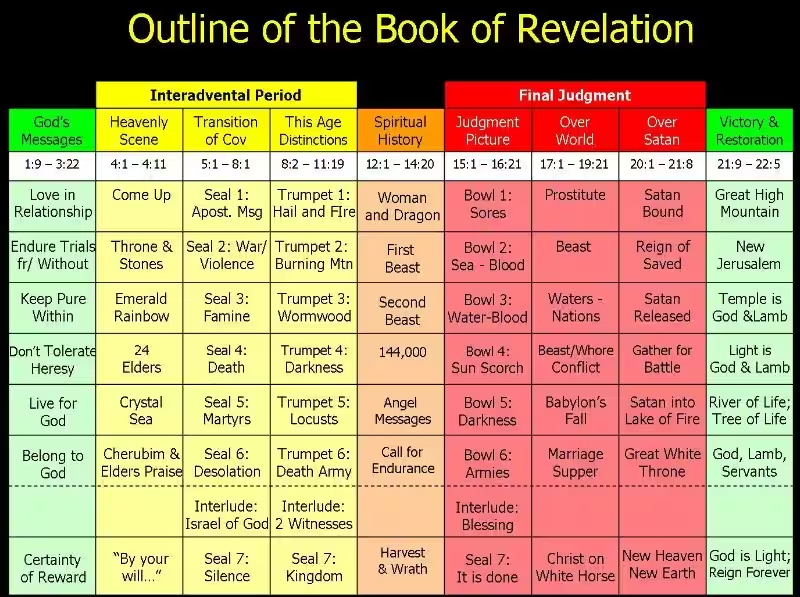
One of the most direct references to Israel in Revelation comes in the form of the 144,000 sealed from all the tribes of Israel. Chapter 7 of Revelation vividly describes 12,000 sealed from each of the twelve tribes: Judah, Reuben, Gad, Asher, Naphtali, Manasseh, Simeon, Levi, Issachar, Zebulun, Joseph, and Benjamin. This selection is significant. It suggests a divinely protected remnant during a time of immense tribulation, highlighting that God’s focus remains, in some capacity, on His original covenant people. This isn’t just a random listing; it’s a deliberate inclusion that underscores a continuing divine purpose for those descended from Abraham, Isaac, and Jacob.
It’s crucial to understand that these “tribes” might not be literal, ethnic enumerations in every interpretation. Many scholars believe this refers to a spiritual Israel, encompassing all believers, both Jewish and Gentile, who have faith in Jesus Christ. However, other interpretations maintain a distinct, literal significance for the physical nation and its people. Regardless of interpretative lens, the mention of the tribes of Israel signifies divine order and preservation, a promise that even amidst chaos, God has a plan for His people. Think of it like a family crest; even if members are scattered, the crest represents a shared heritage and enduring connection. The mention of these specific tribes serves a similar symbolic, or literal, purpose.
Another potent image often associated with Israel is the woman clothed with the sun, with the moon under her feet and a crown of twelve stars on her head, found in Revelation 12. This woman gives birth to a male child who is caught up to God and His throne, while she flees into the wilderness for 1,260 days. While interpretations vary, a widely held view is that this woman symbolizes Israel, the mother of the Messiah. The sun represents God’s glory, the moon His creation, and the twelve stars could represent the twelve tribes or the twelve apostles, signifying the continuity of God’s redemptive lineage through Israel.
This woman’s subsequent flight into the wilderness for a period of persecution and sustenance is often seen as a prophetic depiction of Israel’s future trials and God’s miraculous provision. Revelation says that during this time, the earth helps the woman, swallowing the flood of water the dragon (Satan) spews at her. This image is deeply comforting; it portrays God actively intervening to protect His people even when they are in their most vulnerable state. It’s a powerful reminder that even in the darkest hours, divine protection is assured for those with whom God has an enduring covenant.
God’s Judgment and Israel’s Future
The “Great Tribulation” and its Impact
Revelation speaks extensively about periods of intense judgment and tribulation that will precede the ultimate establishment of God’s kingdom. Within this context, the question of “What does Revelation say about Israel?” often leads to discussions about the nation’s role during these trying times. Some interpretations suggest that Israel, both as a nation and as individuals, will face severe persecution during this period, testing their faith and allegiance. The imagery of the “great tribulation” is often understood as a time of unparalleled suffering for the entire world, and specific prophecies might indicate a concentrated focus on the Jewish people.
However, Revelation also offers a message of hope and ultimate deliverance for Israel. As mentioned, the 144,000 are sealed for protection, and the woman is sustained in the wilderness. This duality of judgment and mercy is a recurring theme in Scripture. It’s not a simple narrative of condemnation, but rather a process of purification and refinement. God may allow trials to bring His people closer to Him, to remove impurities, and to prepare them for a glorious future. This is akin to a blacksmith working metal; the intense heat and hammering are necessary to shape and strengthen the final product.
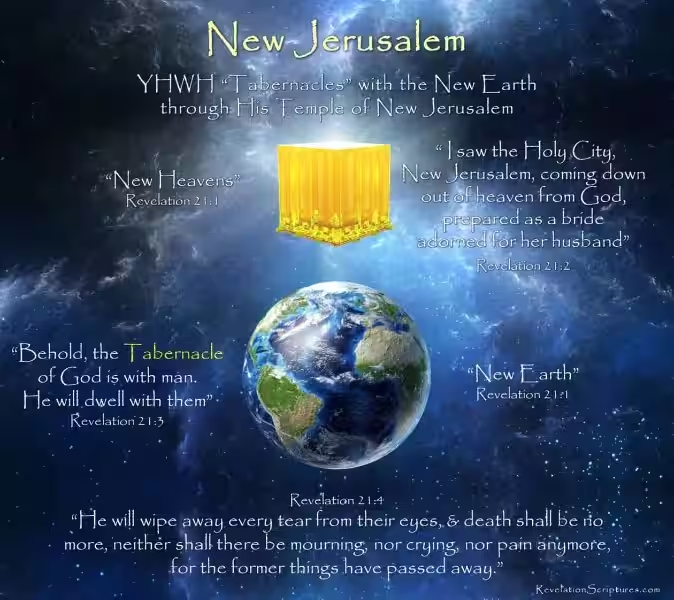
A significant portion of Revelation’s message concerning Israel points towards ultimate restoration and a glorious future. The book culminates in the vision of the New Jerusalem, a heavenly city descending to earth. While this city is for all of God’s redeemed people, the foundations are described as having the names of the twelve apostles, and the gates bear the names of the twelve tribes of Israel (Revelation 21:12). This is a profound indication of Israel’s integral and foundational role in God’s eternal plan.
The presence of the tribes’ names on the gates of the New Jerusalem signifies that Israel’s identity and covenantal heritage are not discarded but are incorporated into the consummation of God’s kingdom. It suggests a future where the distinction between Jew and Gentile, in terms of salvation, is no longer a barrier, but where the unique history and calling of Israel are honored and fulfilled. This is a powerful assurance that God’s promises to Abraham and his descendants are eternal and unbreakable, culminating in a redeemed people dwelling in God’s presence forever.
Interpretative Challenges and Enduring Significance
Navigating Symbolic Language
One of the primary challenges in understanding “What does Revelation say about Israel?” lies in deciphering its highly symbolic and apocalyptic language. Revelation is not a historical chronicle or a literal roadmap. Its imagery of beasts, dragons, trumpets, and seals is meant to convey spiritual truths and cosmic realities. For instance, the “beast” is often interpreted as representing oppressive political or religious systems, and applying these symbols directly to specific modern-day nations or leaders without careful hermeneutical consideration can lead to misinterpretations. Context is paramount, and understanding the literary genre is crucial for accurate interpretation.
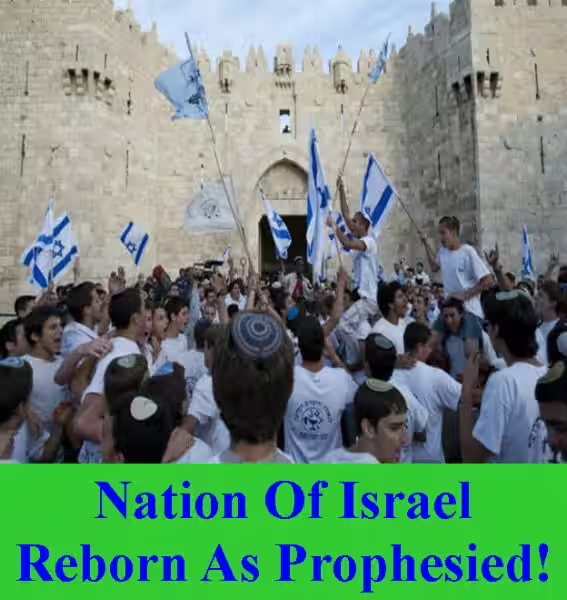
The ambiguity of certain passages allows for diverse theological viewpoints. Some proponents of dispensationalism, for example, often interpret Revelation as having a literal fulfillment for the modern nation of Israel, emphasizing a future rebuilding of the Temple and a distinct role for Jewish people in end-times events. Conversely, preterist interpretations view most of Revelation’s prophecies as already fulfilled in the first century. Historicist views see the prophecies unfolding throughout church history, while futurist interpretations focus on events yet to come. Each approach offers a different lens through which to understand the prophetic references to Israel.
The Enduring Covenant and God’s Faithfulness
Regardless of the specific interpretive framework, the enduring significance of “What does Revelation say about Israel?” lies in its affirmation of God’s faithfulness to His covenant promises. The book consistently points to God’s ultimate victory over evil and the establishment of His righteous kingdom. Within this grand narrative, Israel, with its complex history of obedience and disobedience, remains a central figure. Revelation assures believers that God’s plans are unfolding perfectly, even amidst the turmoil and opposition depicted in the visions.
The message of Revelation regarding Israel serves as a powerful reminder to all believers about the sovereignty of God and the certainty of His redemptive purposes. It underscores that God’s dealings with His chosen people are not arbitrary but are rooted in His unconditional love and unwavering commitment. For those who identify with Israel, whether by lineage or by faith, Revelation offers both a warning of the trials to come and an unparalleled promise of ultimate glory and peace within God’s eternal reign. The book’s final vision of a renewed creation, free from sin and suffering, is the ultimate fulfillment of all God’s promises, including those made to Israel.
Frequently Asked Questions about Revelation and Israel
What does Revelation say about Israel?
Revelation mentions Israel in several contexts. In chapter 7, it speaks of the sealing of 144,000 servants from the tribes of Israel. Later, in chapter 12, a woman “clothed with the sun, with the moon under her feet and a crown of twelve stars on her head” is described, who gives birth to a male child. This woman is widely interpreted by many Christians as representing Israel. The book also speaks of a future restoration and regathering of Israel.
How does Revelation relate to the religion of Judaism?
While Revelation is a Christian book, it draws heavily on Jewish scriptures and imagery. Many of the symbols and prophecies in Revelation have their roots in the Old Testament of the Bible, which is the central text of Judaism. Some interpretations of Revelation see connections to Jewish eschatological (end-times) beliefs, though the book’s ultimate focus is on the fulfillment of God’s plan through Jesus Christ, a concept central to Christianity but not to Judaism.
What is the significance of the “new Jerusalem” in Revelation?
The “new Jerusalem” is depicted in Revelation as a heavenly city that descends from God. It is described as a place of perfection, where there is no more death, mourning, crying, or pain. For Christians, it represents the ultimate dwelling place of God with His redeemed people, a culmination of God’s plan for salvation and a new reality free from sin and suffering.