The spiritual heart of Catholicism, the Vatican City, is an unparalleled repository of religious history and artistic masterpieces. Yet, beneath the grandeur of St. Peter’s Basilica and the awe-inspiring frescoes of the Sistine Chapel lies another, equally profound, narrative – one of archaeological discovery and meticulous preservation. This is the realm of the Excavations Office of the Vatican, a dedicated body whose work is not merely about digging in the dirt, but about unearthing the very foundations of faith and understanding.
For centuries, the Vatican has been a focal point for pilgrims and scholars alike, drawn by its deep religious significance. However, the physical landscape of this sacred enclave has also been a source of intense historical and theological interest. The Excavations Office of the Vatican plays a crucial role in this ongoing quest, meticulously uncovering and interpreting the layers of human history intertwined with the development of Christianity. Their work goes far beyond mere artifact collection; it is a sacred trust, a commitment to preserving the tangible echoes of those who came before and whose lives shaped the religious landscape we know today.
The Unseen Depths: What the Vatican Excavations Uncover
The term “excavations” might conjure images of dusty trowels and ancient pottery shards, and while these elements are certainly part of the process, the work of the Excavations Office of the Vatican is far more sophisticated and deeply rooted in religious context. Their investigations are driven by a profound desire to understand the origins, evolution, and physical manifestation of religious beliefs and practices. This often involves delving into areas that have remained hidden for millennia, revealing insights that can profoundly impact our understanding of religious narratives.
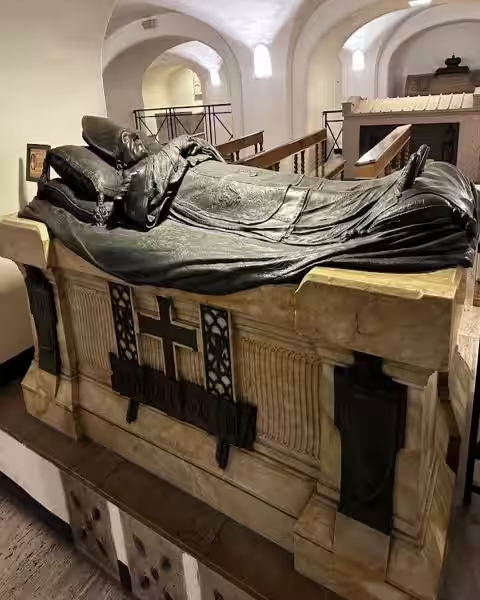
One of the most famous and impactful endeavors undertaken by the Excavations Office of the Vatican was the exploration beneath St. Peter’s Basilica. This led to the discovery of the necropolis, a vast ancient cemetery that predates the current basilica. Within this hallowed ground, archaeologists uncovered tombs, mausoleums, and inscriptions that provided invaluable historical and theological evidence regarding early Christian burial practices and the veneration of saints. Imagine finding a personal inscription from a Roman citizen in the 2nd century, describing their devotion to a particular martyr – this is the kind of direct connection to the past that the Excavations Office of the Vatican facilitates.
Beyond the Basilica: A Wider Scope of Religious Exploration
The mandate of the Excavations Office of the Vatican is not confined solely to the immediate vicinity of its most iconic structures. Their work extends to various sites of religious importance, both within Vatican City and in collaboration with archaeological projects internationally that hold significance for Catholic history. This broader scope allows for a more comprehensive understanding of how religious faith has been expressed and practiced across different times and places, bringing to light forgotten chapels, early Christian dwellings, and devotional artifacts.
Consider, for example, the study of early Christian catacombs outside Rome. While not directly under the purview of constant excavation by the Vatican office, their expertise and historical knowledge are often sought and contribute to the broader understanding of early Christian life and worship. The Excavations Office of the Vatican acts as a central hub of knowledge and methodology, ensuring that discoveries, wherever they may occur, are interpreted within the rich tapestry of religious history. They are the guardians of not just physical remains, but of the narratives they tell about human devotion.
The Intersection of Archaeology and Faith: A Symbiotic Relationship
The work of the Excavations Office of the Vatican beautifully illustrates the symbiotic relationship between archaeology and religion. Archaeological findings can provide tangible proof and context for religious narratives, while religious faith provides a powerful motivator and framework for archaeological investigation. This is not about proving or disproving faith, but about enriching it with historical understanding and making its journey through time more accessible.
The meticulous process employed by the Excavations Office of the Vatican involves a range of scientific techniques, from carbon dating to advanced imaging. However, at its core, it is driven by a deep respect for the sacred nature of the sites and artifacts they encounter. Each find is treated with reverence, and every interpretation is approached with a blend of scientific rigor and theological sensitivity. For instance, when the Excavations Office of the Vatican uncovers fragments of early liturgical vessels, it’s not just about identifying the material; it’s about contemplating the hands that held them and the prayers that were offered.
The primary mission of the Excavations Office of the Vatican extends beyond the act of discovery; it encompasses the long-term preservation and study of these invaluable religious heritage sites. This involves careful documentation, conservation efforts, and the dissemination of knowledge through academic publications and public exhibitions. Their commitment ensures that the sacred history they unearth remains accessible and understandable for generations to come.
Imagine a pilgrim standing in the Vatican today, gazing at the ancient sarcophagi or the epigraphic evidence of early Christian communities. Their experience is immeasurably enriched by the work of the Excavations Office of the Vatican, which has painstakingly brought these remnants of the past to light and explained their significance. It is through their dedication that the weight of history and the endurance of faith become palpable, offering a profound connection to the spiritual lineage that continues to shape the world. The Excavations Office of the Vatican is, in essence, a bridge between the past and the present, allowing us to walk in the footsteps of those who laid the foundations of our religious beliefs.
Frequently Asked Questions: Excavations Office, Vatican City
What is the Excavations Office of the Vatican?
The Excavations Office of the Vatican (Ufficio Scavi) is the department responsible for archaeological research and excavations within Vatican City, particularly for the ongoing investigation and preservation of the Vatican Necropolis, which lies beneath St. Peter’s Basilica.
What is the primary focus of the Excavations Office?
Its primary focus is the scientific excavation, study, and preservation of the ancient Roman cemetery (necropolis) discovered beneath St. Peter’s Basilica, believing it to be the burial site of Saint Peter.
Can the public visit the Vatican Necropolis excavations?
Yes, guided tours of the Vatican Necropolis, managed by the Excavations Office, are available to the public. These tours require prior booking and are highly sought after.
What can visitors expect to see during a tour of the Necropolis?
Visitors can expect to see well-preserved tombs, mausoleums, frescoes, inscriptions, and other archaeological remains dating back to the 1st to 4th centuries AD, offering a glimpse into early Christian and Roman burial practices.
How does the Excavations Office contribute to religious understanding?
By scientifically investigating the presumed tomb of Saint Peter, the Excavations Office provides historical and archaeological evidence that supports the Catholic Church’s tradition and the theological significance of St. Peter’s Basilica as the principal apostolic see.
Is the Vatican Necropolis an active religious site?
While it is a site of immense religious significance and an active archaeological zone under careful management, it is not a place of active worship in the same way as the basilica above. Access is strictly controlled for preservation and research purposes.
Who oversees the work of the Excavations Office?
The Excavations Office operates under the authority of the Fabric of Saint Peter (Fabbrica di San Pietro), the pontifical commission responsible for the maintenance, preservation, and administration of St. Peter’s Basilica and its surroundings.
What is the significance of the “Tomb of St. Peter”?
The ongoing research by the Excavations Office aims to definitively identify and preserve the tomb believed to be that of Saint Peter, the first Pope, a cornerstone of Catholic faith and tradition.