In the rich tapestry of Christian devotion, certain practices stand out for their enduring power and ability to draw believers closer to the divine. Among these, the Theotokos Rosary holds a special place, offering a profound and contemplative approach to prayer that centers on the life and intercession of Mary, the Mother of God. More than just a string of beads, it is a spiritual tool, a pathway to deeper understanding, and a powerful expression of religion. This article will explore the significance of the Theotokos Rosary, its unique connection to Marian devotion within Christianity, and how its practice can enrich your own spiritual journey.
Understanding the Term: “Theotokos” and its Significance
The word “Theotokos” is an ancient Greek term that literally translates to “God-bearer” or “Mother of God.” It’s a title deeply revered within Orthodox and Catholic Christianity, emphasizing Mary’s unique role as the mother of Jesus Christ, who is believed to be both fully God and fully human. This theological understanding is foundational to the Theotokos Rosary, as it frames each prayerful reflection within the context of Mary’s intimate relationship with Christ and her pivotal role in salvation history.
The title “Theotokos” was officially recognized at the Council of Ephesus in 431 AD, a significant event in the history of Christian dogma. This affirmation solidified the belief that Mary was not merely the mother of Jesus’ human nature, but the mother of the divine person of Jesus. For those praying the Theotokos Rosary, this title serves as a constant reminder of the profound mystery of the Incarnation and Mary’s co-operation in God’s plan for humanity. It’s a central tenet of religion that elevates Mary to a position of immense spiritual importance, a motherly figure who can guide and intercede for us.
The Structure and Prayerful Progression of the Theotokos Rosary
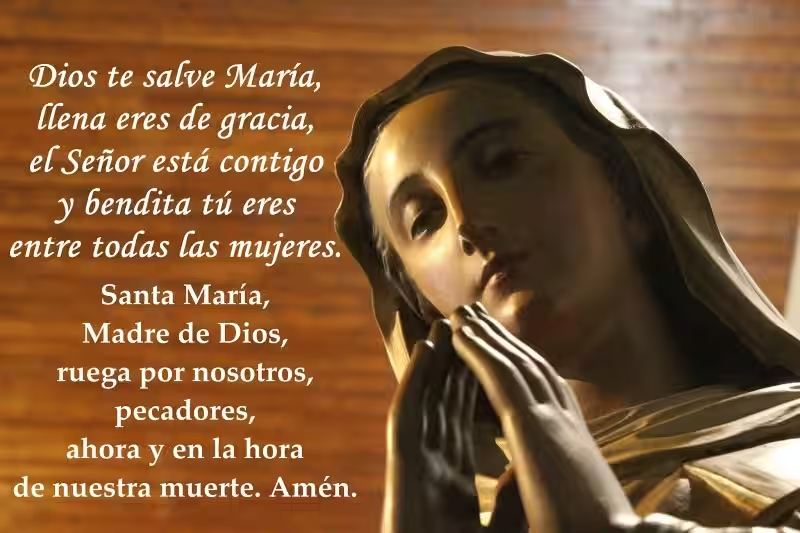
While sharing similarities with the traditional Rosary, the Theotokos Rosary often incorporates specific prayers and meditations that highlight Mary’s virtues, her experiences, and her role as a spiritual mother. It typically involves reciting a series of prayers like the Hail Mary, Our Father, and Glory Be, interspersed with meditations on specific mysteries or events in the lives of Jesus and Mary. The Theotokos Rosary often places a particular emphasis on the joyful, sorrowful, and glorious events, but with a distinctly Marian perspective.
A key element differentiating the Theotokos Rosary is the intentional focus on Mary’s perspective and her emotional and spiritual journey. For instance, when meditating on the Annunciation, one might contemplate Mary’s humble acceptance of God’s will, her awe, and her deep faith. This focus on religion through Mary’s eyes allows for a more intimate and personal connection to the events of salvation. The structure encourages a slow, deliberate pace, allowing for genuine reflection rather than rapid recitation, making it a truly contemplative practice.
Key Elements of a Theotokos Rosary Prayer
The Hail Mary: Often recited with a particular intention focused on Mary’s intercession or a specific virtue she exemplified.
The Apostles’ Creed: A foundational statement of Christian belief recited at the beginning, setting the theological framework.
The Our Father: A prayer taught by Jesus himself, connecting the devotee directly to God the Father.
The Glory Be: An expression of praise and adoration to the Holy Trinity, acknowledging the divine nature.
Meditations on Mysteries: These are central to the Theotokos Rosary, focusing on significant events in the lives of Jesus and Mary, often with a specific emphasis on Mary’s experience.
Common Mysteries Meditated Upon in the Theotokos Rosary
The Theotokos Rosary typically follows a cycle of mysteries, similar to the traditional Rosary, but with a nuanced Marian focus:
The Joyful Mysteries: Often include the Annunciation, the Visitation, the Nativity, the Presentation of Jesus in the Temple, and the Finding of Jesus in the Temple. Each mystery invites reflection on Mary’s joy and her role in bringing Christ into the world.
The Sorrowful Mysteries: Focus on Christ’s passion and death, but also contemplate Mary’s profound sorrow and her unwavering love for her son. These might include the Agony in the Garden, the Scourging at the Pillar, the Crowning with Thorns, the Carrying of the Cross, and the Crucifixion.
The Glorious Mysteries: Celebrate Christ’s resurrection and ascension, and Mary’s subsequent glorification, including her Assumption and the Coronation of Mary as Queen of Heaven and Earth. These mysteries inspire hope and contemplation of eternal life.
The Luminous Mysteries (Optional): Introduced by Pope John Paul II, these focus on key moments in Christ’s public ministry, such as his Baptism, the Wedding at Cana, his Proclamation of the Kingdom, the Transfiguration, and the Institution of the Eucharist. The Theotokos Rosary may incorporate these, reflecting on Mary’s presence and guidance during these pivotal events.
The Theotokos Rosary: A Bridge to Deeper Spiritual Life
The practice of the Theotokos Rosary is not merely a ritualistic repetition of prayers; it is an invitation to enter into a profound dialogue with the divine through the intercession of Mary. By meditating on the mysteries of Christ’s life through the eyes of his mother, believers can gain a richer understanding of the Gospel narratives and develop a more intimate relationship with God. This form of religion fosters a contemplative spirit, encouraging us to pause, reflect, and allow the spiritual truths to penetrate our hearts.
Many find that consistently praying the Theotokos Rosary cultivates a sense of peace and spiritual grounding. It provides a structured way to bring our daily worries, joys, and petitions before God, confident in Mary’s loving intercession. The repetitive nature of the prayers, when approached with intention, can act as a meditative anchor, quieting the mind and allowing for deeper spiritual awareness. This practice can transform the mundane act of praying into a powerful spiritual exercise, connecting us to a rich tradition of faith.
Cultivating Virtues Through Theotokos Rosary Practice
As you engage with the Theotokos Rosary, you are not just reciting prayers; you are actively cultivating virtues that Mary herself embodied. Consider the virtue of humility: Mary’s response to the angel Gabriel, “Behold, I am the handmaid of the Lord; let it be to me according to your word,” is a perfect example of profound humility. When we meditate on this mystery, we are encouraged to embrace our own roles in God’s plan with similar humility.
Another key virtue is faith. Mary’s journey was marked by immense faith, from the initial announcement to the foot of the cross. Praying the Theotokos Rosary invites us to strengthen our own faith, trusting in God’s providence even when circumstances are difficult. Similarly, the virtue of charity is exemplified in Mary’s prompt journey to visit her cousin Elizabeth, a selfless act of love and service. The Theotokos Rosary encourages us to reflect on how we can better extend charity to others.
Practical Tips for Engaging with the Theotokos Rosary
To truly benefit from the Theotokos Rosary, consider these practical tips:
Find a quiet space: Dedicate a time and place where you can pray without distractions. This could be a church, a quiet corner of your home, or even a peaceful walk in nature.
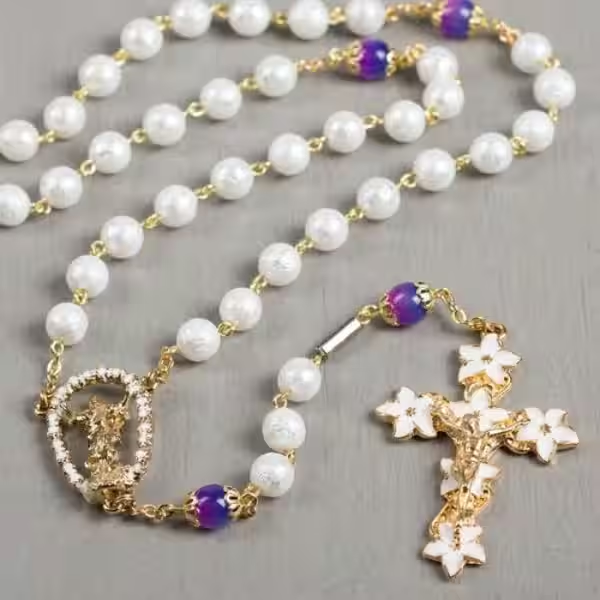
Use a physical rosary: The tactile nature of the beads can be helpful in keeping track of prayers and staying focused. Many specific Theotokos Rosary beads are available, often featuring images of Mary.
Focus on one mystery at a time: Don’t rush through the prayers. Take time to truly meditate on the meaning of each mystery and how it applies to your life.
Pray with intention: Bring specific intentions to your prayer – for yourself, for loved ones, for the world. Entrust these intentions to Mary’s motherly care.
Consider joining a group: Praying the Theotokos Rosary with others can be a deeply enriching experience, fostering a sense of community and shared devotion.
The Theotokos Rosary in the Broader Context of Religion
The Theotokos Rosary is a beautiful testament to the multifaceted nature of religion. It demonstrates how prayer can be structured, meditative, and deeply personal, all at once. It highlights the importance of intercessory prayer, recognizing that we are not alone on our spiritual journey and that we can draw strength from the communion of saints, particularly from Mary, the Mother of God. This practice underscores the belief that faith is not merely intellectual assent but a lived experience, a relationship built on love and trust.
Ultimately, the Theotokos Rosary offers a profound way to connect with the divine, to grow in virtue, and to experience the loving intercession of Mary. Whether you are a seasoned practitioner or new to this form of devotion, the Theotokos Rosary invites you on a journey of faith, contemplation, and transformative encounters with God. It is a timeless practice that continues to offer solace, guidance, and a deeper understanding of the mysteries of our faith, enriching the spiritual lives of countless individuals across generations, and solidifying its place as a vital element within the broader landscape of religion.
Frequently Asked Questions about the Theotokos Rosary
What is the Theotokos Rosary?
The Theotokos Rosary is a specific form of prayer derived from the tradition of praying the Rosary, particularly within Eastern Orthodox Christianity. It is sometimes referred to as the “Rosary of the Theotokos” or simply the “Orthodox Rosary.” It is a meditative prayer that focuses on the life and virtues of the Theotokos (the Mother of God, Mary) and the life of Jesus Christ.
What is the difference between a Catholic Rosary and the Theotokos Rosary?
While both use prayer beads and involve meditation on the life of Christ and Mary, there are key differences. The Catholic Rosary typically has 15 or 20 decades, with specific Mysteries (Joyful, Sorrowful, Glorious, Luminous) assigned to each decade. The Theotokos Rosary, in its common forms, often involves praying a set number of prayers (like the Jesus Prayer or the Hail Mary) while meditating on specific themes or icons related to the Theotokos and Christ. It is less standardized in terms of the exact number of decades or specific “Mysteries” in the same way as the Catholic Rosary. The focus is often on the Theotokos’ humility, obedience, and her role in salvation.
What kind of beads are used for a Theotokos Rosary?
The beads themselves can vary greatly. They might be made of wood, stone, glass, or other materials. The number of beads is also not as rigidly defined as in the Catholic Rosary. Some Orthodox prayer ropes (chotki) have 100 or 33 beads, and these are often used for repetitive prayer like the Jesus Prayer, which can be incorporated into a Theotokos devotion. Other forms might use beads similar in number to a Catholic Rosary but with a more flexible structure.
How do you pray the Theotokos Rosary?
There isn’t one single, universally prescribed method. A common approach involves using the beads to count prayers while meditating on specific aspects of the Theotokos’ life and her relationship with Christ. This could include reflecting on the Annunciation, the Nativity, her sorrows at the foot of the Cross, or her role as the Theotokos. Prayers such as the Hail Mary (often adapted with Orthodox phrasing), the Jesus Prayer (“Lord Jesus Christ, Son of God, have mercy on me, a sinner”), or the Trisagion (“Holy God, Holy Mighty, Holy Immortal, have mercy on us”) can be incorporated. Often, a specific icon of the Theotokos is used as a focal point for meditation.
What is the purpose of praying the Theotokos Rosary?
The primary purpose is to draw closer to God through a deeper understanding and imitation of the virtues of the Theotokos. It’s a devotional practice aimed at increasing love for Christ, fostering humility, seeking intercession from the Mother of God, and growing in spiritual life. It is a tool for contemplative prayer and a way to keep one’s mind focused on spiritual realities throughout the day.
Is the Theotokos Rosary a Catholic practice?
While the practice of praying with beads and meditating on the life of Christ and Mary is common in many Christian traditions, the term “Theotokos Rosary” is most closely associated with Eastern Orthodox Christianity. The Catholic Church has its own distinct Rosary tradition with its own set of prayers and Mysteries.
Can non-Orthodox Christians pray the Theotokos Rosary?
Many elements of prayer and devotion are shared across Christian denominations. Individuals from other Christian backgrounds who are drawn to the veneration of the Theotokos and wish to meditate on her life and virtues may find the Theotokos Rosary a meaningful practice. However, it’s important to approach it with an understanding of its Orthodox context and theological underpinnings.